This guide ranks six DeFi APIs for 2026. Each one is mapped to the job it does best. We also cover the execution layer most data guides skip.
How to Choose the Best DeFi API
Position interpretation beats raw logs.
Anyone can serve event logs. Fewer APIs can tell you what a wallet actually holds. Staked tokens, LP shares, and lending collateral need decoding. APIs that resolve positions save weeks of indexer work.
Coverage should match where value lives.
Twenty well-indexed chains beat eighty shallow ones. Check protocol depth, not just chain count. For chain-specific picks, see our Solana API providers guide. The same logic applies to every ecosystem.
Pricing models shape your roadmap.
Free tiers vary widely in what they include. Credit-based plans scale better than hard call caps. We compared entry plans in our free crypto API comparison. Factor in the upgrade path early.
The Execution Layer: StealthEX
DeFi APIs deliver data: positions, balances, protocol metrics. At some point, users want to act on that data. Something has to execute the swap. That step is the execution layer, and it’s where StealthEX sits.
Our instant exchange API embeds non-custodial swaps into crypto products. Coverage spans 2,000+ cryptocurrencies and 100+ fiat currencies. Swaps run in fixed-rate and floating-rate mode. Floating rates match the market at execution; fixed rates lock the received amount.
The user experience stays light. No accounts are required, and no mandatory KYC applies to standard swaps. The average swap completes in under 15 minutes. Wallets, dashboards, aggregators, and trading terminals integrate it in hours.
The pricing model removes the usual friction. Integration is free, with no subscriptions or call caps. Partners set a commission between 0 and 0.5 percent per swap, with revenue sharing. White-label options cover fully branded experiences.
If your product only reads DeFi data, the six APIs below cover everything. If users should act on that data, pair one with StealthEX. One integration turns a read-only product into an actionable one.
The Best DeFi APIs of 2026
1. CoinStats Wallet API: All-in-One DeFi Data Layer
CoinStats Wallet API fits most DeFi data use cases. Pass a wallet address and get balances, transactions, and DeFi positions. Positions resolve automatically across 10,000+ protocols. No per-protocol integration work is needed.
Coverage spans 120+ blockchains through one endpoint format. The response schema is identical on every chain. Staked assets, LP shares, and lending collateral arrive decoded. The same infrastructure powers an app with 1M monthly users.
CoinStats API bundles market data behind the same key. Prices cover 100,000+ coins across 200+ exchanges. Portfolio analytics and token security for EVM chains round it out. The formula: market data + wallets + DeFi + portfolio analytics + token security.
CoinStats MCP Server exposes the same data as callable tools. AI agents on Claude or Cursor can query DeFi positions directly. Pricing is credit-based with a free tier, no card required. A deeper endpoint breakdown sits in this DeFi APIs guide.
Snapshot:
- DeFi positions auto-detected across 10,000+ protocols.
- 120+ blockchains in one response schema.
- Decoded staking, liquidity, and lending positions.
- Market data for 100,000+ coins and 200+ exchanges.
- Token security checks on EVM chains.
- MCP Server for AI agents and LLM apps.
- Credit-based free tier at signup.
Best Suited For: Most DeFi data use cases. Portfolio trackers, DeFi dashboards, tax tools, and AI-powered assistants needing positions plus market data.
2. Covalent (GoldRush): Granular Onchain Data
Covalent indexes raw blockchain activity under its GoldRush brand. The API exposes event logs, balances, and full transaction histories. That log-level depth suits protocol analytics and custom DeFi metrics. Chains share one schema, so multi-chain queries stay uniform.
Coverage reaches 100+ networks. SDKs ship for TypeScript, Python, and Go. A streaming API delivers sub-second updates for live dashboards. An MCP server supports AI coding agents.
The tradeoff is interpretation. GoldRush returns what happened onchain, not what a position means. Turning logs into staked balances or LP values is your job. Teams wanting decoded positions should look at entries one and six.
Snapshot:
- 100+ blockchains in one schema.
- Event logs, balances, and transaction histories.
- Streaming API with sub-second updates.
- SDKs in TypeScript, Python, and Go.
- MCP server for AI coding agents.
Best Suited For: Protocol teams and analytics builders working from raw, log-level onchain data.
3. Expand Network: Unified DeFi Endpoints With Execution
Expand Network by Blockdaemon unifies DeFi protocols behind one API. Around 170 endpoints cover DEXs, lending, bridges, yield aggregators, and oracles. The API spans EVM and non-EVM chains alike. Data and transaction endpoints sit side by side.
Execution is the differentiator. Apps can quote a swap, then submit it through the same interface. Lending actions like deposits and withdrawals work the same way. The model stays non-custodial, with end users signing every transaction.
The tradeoff is wallet-level breadth. Expand Network is organized around protocols, not portfolios. Aggregating one wallet’s full DeFi footprint takes extra assembly work.
Snapshot:
- 170+ endpoints across DeFi primitives.
- DEX, lending, bridge, oracle, and yield coverage.
- Data plus non-custodial transaction execution.
- EVM and non-EVM chain support.
Best Suited For: Trading systems and institutional tools that transact on DeFi protocols, not just read them.
4. Footprint Analytics: DeFi Metrics and Research Data
Footprint Analytics abstracts raw chains into structured, queryable tables. Its Data API serves DeFi and GameFi metrics across 30+ chains. Both raw records and pre-computed statistics are available. SQL access complements the REST endpoints.
The platform leans toward research and dashboards. No-code charting sits next to the API for quick exploration. Teams can prototype a metric visually, then productionize it via API.
The tradeoff is real-time wallet work. Footprint Analytics is built for metrics, not live portfolio rendering. Aggregate TVL trends fit better than per-user position lookups.
Snapshot:
- Structured DeFi tables across 30+ chains.
- Raw records plus pre-computed metrics.
- SQL and REST access in one platform.
- No-code dashboards for fast prototyping.
- Free tier with entry plans from $20 per month.
Best Suited For: Analysts and data teams building DeFi research products and metric dashboards.
5. DappRadar API: Dapp Rankings and Usage Data
DappRadar tracks decentralized applications across 90+ chains. The API exposes dapp-level metrics: active wallets, transactions, volume, and TVL. A database of 250,000+ smart contracts maps activity to named dapps. Scam alerts flag unlisted or suspicious contracts.
The data answers a distinct question: which dapps are winning? Wallets like OKX and browsers like Opera use it for discovery. Categories span DeFi, gaming, and NFT marketplaces.
The tradeoff is granularity. DappRadar API measures dapps, not individual wallets or positions. It complements a wallet data API rather than replacing one.
Snapshot:
- Dapp metrics across 90+ chains.
- Active wallets, transactions, volume, and TVL.
- 250,000+ smart contract database.
- Scam alerts for contract safety.
- Used by OKX Wallet, Opera, and Blockchain.com.
Best Suited For: Discovery surfaces, wallets, and research tools ranking dapps by real usage.
6. Unmarshal: Decoded Wallet and Protocol Data
Unmarshal runs a decentralized network of blockchain indexers. APIs cover token balances, decoded transactions, and protocol positions. Lending and borrowing positions resolve through its protocol engine. Responses typically land in under 250 milliseconds.
Transaction decoding is a highlight. Each transaction returns with a one-line, human-readable description. Wallet notifications and websockets support real-time products. Coverage spans 50+ chains, mostly EVM networks.
The tradeoff is scope outside EVM. Non-EVM coverage and exchange data stay limited. Protocol position depth varies by chain.
Snapshot:
- Token balances and decoded transactions.
- Protocol positions for lending and borrowing.
- Wallet notifications and websocket streams.
- 50+ chains, primarily EVM.
- Sub-250ms response targets.
Best Suited For: EVM-focused wallets and dashboards wanting decoded transactions with real-time alerts.
DeFi APIs Comparison: Matching Tools to Jobs
Best Overall DeFi Data API
CoinStats Wallet API combines decoded positions, market data, and portfolio analytics. One key covers most DeFi data needs, AI agents included.
Best for Raw Onchain Depth
Covalent fits teams that want log-level data in one schema. Interpretation stays on your side, and flexibility stays high.
Best for Protocol Execution
Expand Network pairs DeFi data with non-custodial transaction endpoints. Trading infrastructure benefits most.
Best for Research and Metrics
Footprint Analytics turns chains into queryable tables. Analysts get SQL, dashboards, and an API in one place.
Best for Dapp Intelligence
DappRadar API ranks dapps by usage, volume, and TVL. Discovery products gain instant context.
Best for Decoded EVM Data
Unmarshal delivers readable transactions and protocol positions with low latency. EVM-first products fit best.
Which DeFi API Should You Choose?
- Choose CoinStats Wallet API for the all-in-one default: Decoded DeFi positions, wallet data, market prices, and MCP support ship together. That breadth fits most builds.
- Choose Covalent when raw logs matter: Protocol analytics and custom metrics benefit from event-level access.
- Choose Expand Network to transact: Swaps, lending actions, and bridge calls run through unified endpoints.
- Choose Footprint Analytics for research: Structured tables and SQL fit analyst workflows.
- Choose DappRadar API for dapp context: Usage rankings and contract safety data enrich discovery products.
- Choose Unmarshal for decoded EVM feeds: Readable transactions and notifications suit real-time wallets.
Conclusion
DeFi APIs split into clear layers. Data APIs decode what wallets and protocols are doing. Analytics APIs measure the market above them. Execution APIs let users act.
For most builds, the data layer comes first. CoinStats Wallet API covers that layer broadly; the others serve sharper niches. StealthEX adds the execution layer when your product is ready.
Ready to put swaps inside your wallet, dashboard, or terminal? Integrate StealthEX crypto exchange through its Affiliate Program and earn from every transaction.
Make sure to follow StealthEX on Medium, X, Telegram, YouTube, and Publish0x to stay updated about the latest news on StealthEX and the rest of the crypto world.
Don’t forget to do your own research before buying any crypto. The views and opinions expressed in this article are solely those of the author.
CoinStats crypto exchange crypto exchange API DeFi exchange API StealthEXThe post Best DeFi APIs in 2026: Developer Guide and Comparison first appeared on StealthEX.]]>
SOL to ETH: A Simple and Straightforward Process
There are many swappers where you can exchange Solana to Ethereum, and StealthEX is one of the safest cross-chain exchanges. This platform offers users to convert SOL to ETH with no extra fees and with the best floating and fixed rates. Such cross-chain exchanges are always freely available via StealthEX.
How to Convert SOL to ETH?
Just follow the guidelines below. Let’s imagine you want to exchange SOL for ETH. To make an exchange, you need to take a few simple steps.
First, you should choose Solana (SOL) in the left drop-down list. Then choose Ethereum (ETH) in the list of coins on the right.
After setting the pair it is necessary to enter the amount of SOL you want to exchange.

Here you will see the estimated amount of ETH that you will receive after the exchange.
Now, when everything is set, press the Start Exchange button and you will be taken to the next page.

In the second step, you need to provide the ETH crypto recipient address. The recipient address must match the crypto you are going to receive. Remember to double-check the information you enter prior to the exchange as the transaction you make cannot be canceled.
As soon as you have carefully checked all the details, you can press the Next button and you will be redirected to the Confirmation page.

Here you can revise the address provided and the amount of Ethereum you will receive. Don’t forget to read and check the Terms of Use and Privacy Policy box. Without checking the box you will not be able to continue the exchange.
Pressing the Next button you will be redirected to the Exchange page.
At first, you will see the address where you need to send your SOL to continue the exchange. StealthEX will also provide you with the exchange ID. It will allow you to keep all the information about the swap. It is recommended to save your exchange ID or the link to your exchange.
Exchange Statuses
After sending Solana coins to the shown address, the information on the Exchange page will be renewed automatically. The Exchange page has several statuses that will change during the time of the exchange.

- The first status is Awaiting deposit.
- The following status is Confirming. This means that StealthEX is confirming the transaction you made.
- The next status is Exchanging. During this time the exchange is being made.
- Then the status will be changed to Sending to your wallet. This indicates that there are just a few minutes until you receive your Ethereum cryptocurrency.
Finally, you will be redirected to the Finish page. This shows that the exchange has been successfully made and you will receive crypto to the address provided. To be sure that Ethereum was sent to your wallet you can also use the Output hash shown on this page and check it in the blockchain list of transactions.
From here you can either create a new exchange on StealthEX.io or leave the page and check your Ethereum wallet to be surprised at how fast you get ETH to your address. Usually, the process is quite rapid so you won’t need to wait long: SOL-ETH crypto swaps are processed in a matter of minutes. Alternatively, you can exchange Ethereum to Solana or choose any other crypto pair available on the platform.
Keep reading StealthEX’s article to learn more about cross-chain swaps.
How Do Cross-Chain Swaps Work?
If you’re already familiar with how a cross-chain bridge works, it’s not a far leap to imagine a cross-chain swap. In brief, a bridge works like this: it takes a deposit of native tokens on Chain A, verifies that deposit, and mints a corresponding number of wrapped tokens on Chain B. One of the uses of cross-chain bridging is a cross-chain swap: trading a token issued on Chain A for a token that is issued on Chain B – all via the decentralized web.
A cross-chain swap works like this: you find a bridge that connects Chain A and Chain B, deposit your Chain A tokens and send a wrapped version of them to the destination chain where your desired token lives. Then, you swap the wrapped tokens via a DEX on the destination.
As you can see, it takes an awful lot of clicks and swaps to get the result you need. This is why state-of-the-art cross-chain swappers like StealthEX crypto exchange are so popular.
Cross-Chain Swaps Use Cases
So how can cross-chain swaps be used? Why would we need them in the first place? Well, they are way more relevant today as the market offers a large number of coins, and they are all built on different blockchains. A user may need to pay for something with a certain cryptocurrency, and that’s where they would need a cross-chain swap. Alternatively, you may want to buy/invest in a certain coin, but it turns out it was made for and in another network. A huge number of cryptocurrencies were created on ETH, BSC, TRX, Solana, Polygon, and these blockchains are the ones where you would need cross-chain swaps the most.
Cross-chain swaps with StealthEX offer a multi-cryptocurrency exchange and independence for its users. Basically, it allows users to swap different crypto between two chains directly. If you’re tired of intermediaries and a long and tiresome process of converting one coin to another, for instance, ETH to Solana, StealthEX should be your number one option.
If you’re looking for a cross-chain exchange or simply want to convert SOL to ETH and ETH to SOL right away, you can do it via StealthEX. Our users can purchase cryptocurrencies using fiat and we still offer the opportunity to buy crypto at fixed rates. You can read more about cross-chain swaps via StealthEX in one of our latest articles.

Make sure to follow us on Medium, X, Telegram, YouTube, and Publish0x to get StealthEX.io updates and the latest news about the crypto world. If you need help, drop us a line at support@stealthex.io.
Please make sure to always research any cryptocurrency and assess your risks before you invest.
cross-chain bridge cross-chain swap Ethereum SOL to ETH SolanaThe post How to Convert SOL to ETH? Solana to Ethereum Bridge first appeared on StealthEX.]]>
In 2012, a new cryptocurrency called Bytecoin (BCN) appeared on the market. One of the benefits of this digital asset was CryptoNote. This algorithm hides the data about the sender and the final recipient of the transaction. The new blockchain attracted users who value their anonymity, but soon it faced criticism from the members of this community. It turned out that as a result of pre-mining, about 80% of coins were credited to the personal wallets of the founders, making mining unprofitable.
In the spring of 2014, the Bytecoin chain went through a hard fork, which resulted in developing a new digital asset. First, Monero had a more complicated name – BitMonero. After the launch, the XMR team improved the wallet interface, secured the code against hacker attacks, and convinced the community to pick a more understandable name for the coin.
Monero’s core development was driven by a group of largely pseudonymous developers led by Riccardo Spagni, also known as Fluffypony. Spagni left his role as lead maintainer of the project in December 2019 to further decentralize Monero’s core development and focus on building products and services on the protocol.
How to Exchange BTC to XMR?
At the moment, it’s very important to support exchanges that work with Monero due to the recent developments in many countries. Since many governments, including India, are looking to ban at least private crypto, including Monero, Zcash and others, it’s crucial for the crypto investors to keep working with the platforms that support these digital assets. Even at times like this, Monero executed a hard fork to be more secure and private, despite the governments’ attack on anonymity tools. If you prefer to use centralized exchanges, you can use the largest ones, including Kraken, Binance, DV Chain or Bitfinex.
Where to Buy Monero?
Right now, the market is experiencing an obvious crackdown on private cryptocurrencies – this is why it’s important to mention the importance of custody-free services supporting XMR, including StealthEX. Our platform provides users with a convenient way to convert Bitcoin to Monero within minutes. The swaps are made on-chain and are performed wallet-to-wallet.
BTC to XMR Exchange
Just go to StealthEX and follow the guidelines below. Let’s imagine you want to exchange BTC to XMR. To make an exchange, you need to take a few simple steps:
First, you should choose Bitcoin in the left drop-down list. Then choose the XMR token in the right list of coins.
After setting the pair it is necessary to enter the amount of BTC you want to exchange.
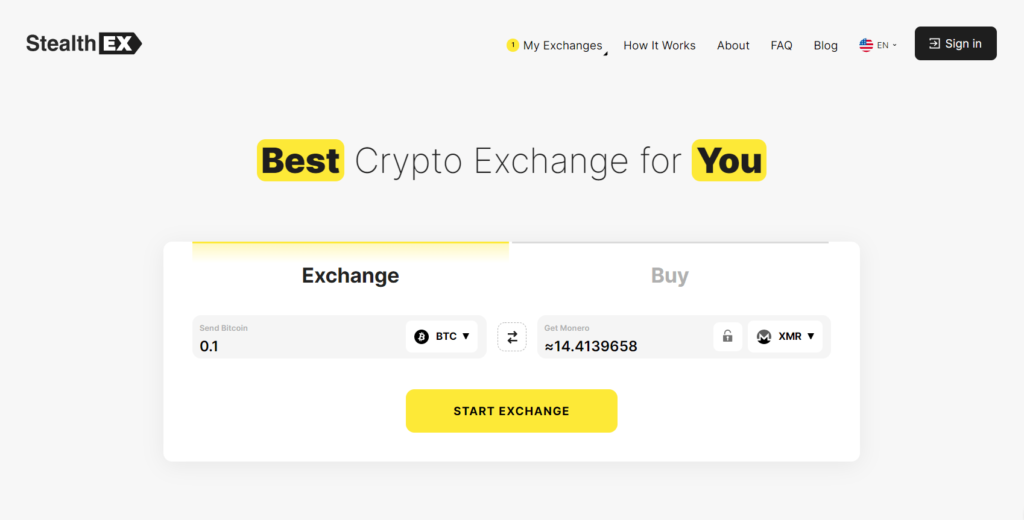
Here you will see the estimated amount of Monero coins that you will receive after the exchange.
Now when everything is set for the exchange, press the Start Exchange button and you will be taken to the next page.
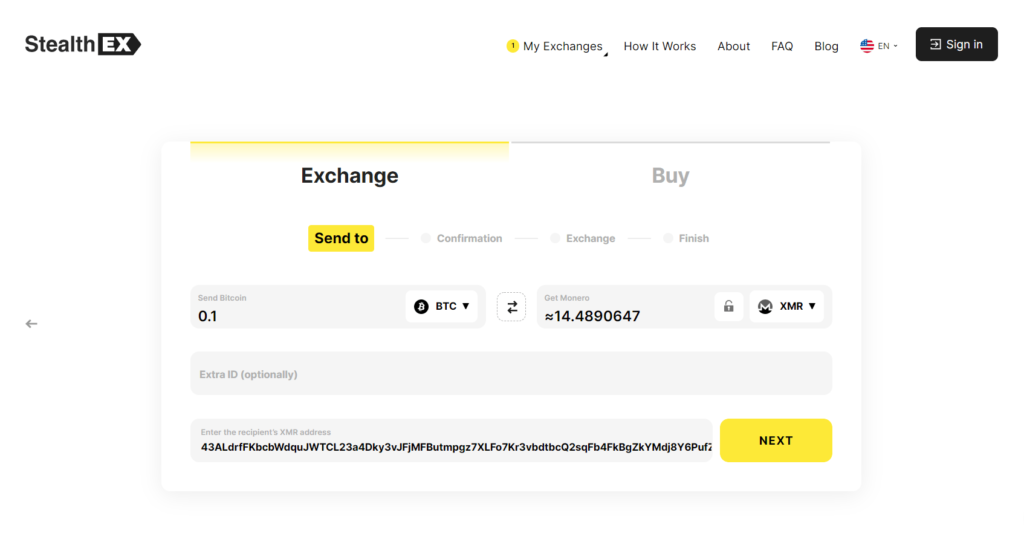
In the second step, you need to provide the XMR recipient address. The recipient address must match the cryptocurrency you are going to receive. Remember to double-check the information you enter prior to the exchange as the transaction you make cannot be canceled.
As soon as you have carefully checked all the details, you can press the Next button and you will be redirected to the Confirmation page with the information about the exchange.
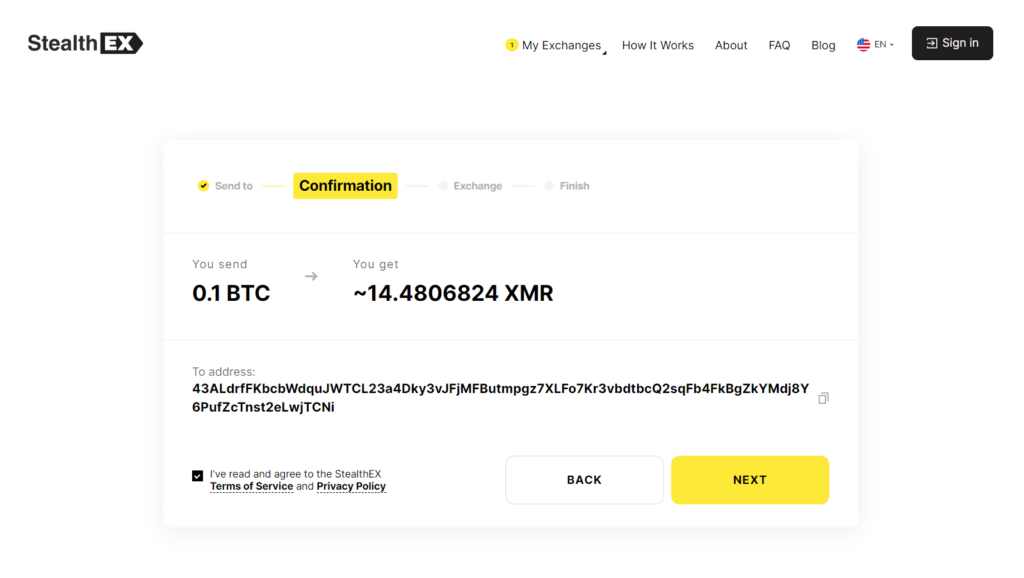
Here, you can revise the address provided and the amount of XMR cryptocurrency you will receive. Don’t forget to read and check the Terms of Use and Privacy Policy box. Without checking the box you will not be able to continue the exchange.
Pressing the Next button you will be redirected to the Exchange page.
At first, you will see the address where you need to send your BTC coin to continue the exchange. StealthEX will also provide you with the exchange ID. It will allow you to keep all the information about the swap. It is recommended to save your exchange ID or the link to your exchange.
Exchange Statuses
After sending BTC coins to the shown address, the information on the Exchange page will be renewed automatically. The Exchange page has several statuses that will change during the time of the exchange.
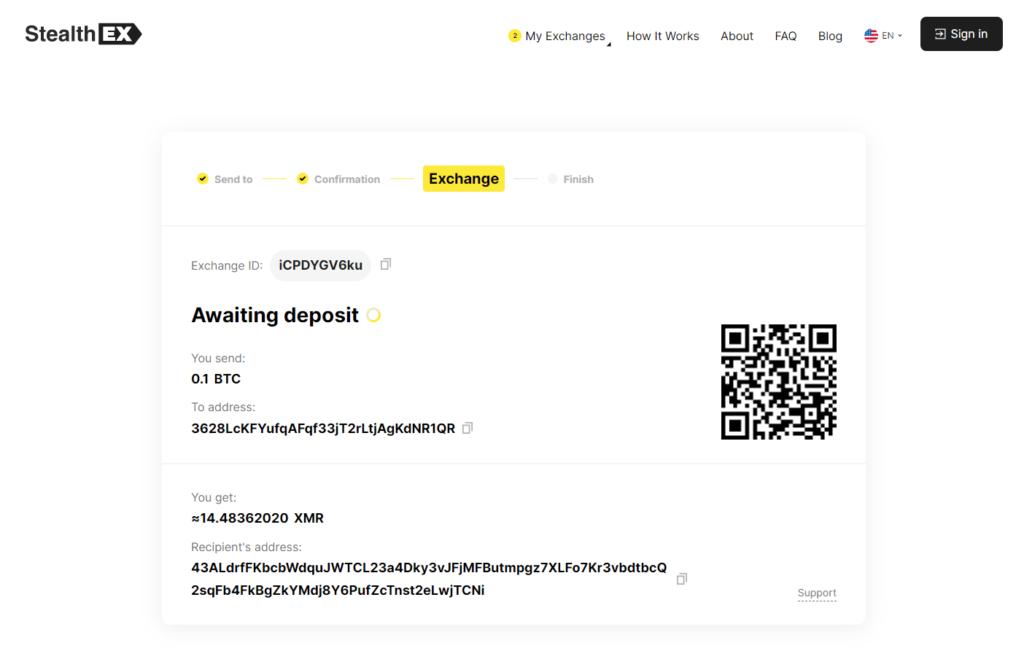
- The first status is Awaiting deposit.
- The following status is Confirming. This means that StealthEX is confirming the transaction you made.
- The next status is Exchanging. During this time the exchange is being made.
- Then the status will be changed to Sending to your wallet. This indicates that there are just a few minutes left until you will receive your Monero XMR coin.
Completion of the Exchange
Finally, you will be redirected to the Finish page. This shows that the exchange has been successfully made and you will receive crypto to the address provided. To be sure that XMR coins were sent to your wallet you can also use the Output hash shown on this page and check it in the blockchain list of transactions.
From here, you can either create a new exchange on StealthEX.io or leave the page and check your Monero coin wallet to be surprised at how fast you got XMR crypto. Usually, the process is quite rapid so you won’t need to wait long.
Keep reading the StealthEX’s article to learn more about Monero project.
BTC vs XMR
Monero is a decentralized, peer-to-peer (P2P) digital currency that aims to make transactions on the blockchain anonymous. Contrary to popular belief, Bitcoin transactions aren’t anonymous. These payments are fully traceable on the public blockchain: it’s even possible to keep an eye on stolen BTC, as we’ve seen following an array of high-profile hacks over the years.
When it comes to Monero vs Bitcoin, there are differences concerning their tokenomics. BTC currently has a circulating supply of around 19.11 million coins – although a sizeable chunk of these are feared to have been lost forever. That means that there are about 1.89 million left to discover in the next 120 years or so. In other words, about 9% of the total supply is still unmined.
Contrast this with Monero – there are more than 18.1 million tokens in circulation and it has met its total supply, but logistically it has no maximum supply. From June 2022, block rewards were scheduled to be fixed at 0.6 XMR per block and under the new software rules, rewards for new blocks will never drop to zero. This is also known as ‘Tail Emission.’
Monero’s Privacy
What’s more, there’s one major difference that sets the Monero and Bitcoin blockchains apart: it’s the cryptography that’s used when transactions are executed. Monero (XMR) uses a technology known as Ring Signatures to ensure that the senders and recipients of a crypto payment cannot be identified.
Monero is considered to have superior privacy over other cryptocurrency projects because of its Ring Signature transaction obfuscation mechanism. In 2020, the IRS offered $1,000,000 to anyone who develops a system for tracking Monero transactions, but no cryptocurrency experts answered the call for proposals with a convincing project.
Monero Crypto Benefits
More people start thinking about where to buy XMR crypto because this token has the following benefits:
- Unlimited issuance. Those, who are looking for how to mine XMR, should know that this process gets more complicated, and the mining of this cryptocurrency is maintained all the time.
- This project uses a larger blockchain, which is approximately 100 GB. For comparison, the chain in the BTC network is over 300 GB.
- PoW algorithm is used for transaction confirmation. The network is supported by miners who find new blocks.
- Protection against the use of ASICs. It’s possible to mine XMR on general processors and video cards. ASIC miners have a high hash rate, but to protect the network from the bigger players, developers are always changing the calculation algorithms. Owners of regular servers react quickly to forks and reconfigure PCs. It’s more complicated for miners to use professional equipment to do so, which decreases the profit of the ASIC mining.
Monero Becomes Even More Private
Just recently, Monero underwent a planned hard fork event, introducing new features to boost its privacy and security. The hard fork brought several fixes to the internal multi-signature mechanism to facilitate the exchange of information such as key sets and data synchronization between wallets.
The network upgrade was delayed from July 13, 2022 when it was first planned for release, and more time needed to resolve hardware wallet incompatibility issues.
Completed in August at block 2,688,888, the hard fork now features a larger ring size (from 11 to 16), an improved ‘Bulletproofs’ algorithm for faster transactions, a revamped multisig mechanism, and performance upgrades that reduce wallet sync times by 30-40%. Monero’s latest network update further boosts transaction source and privacy on an already uncracked system, making it a real challenge for deciphering efforts.
What Wallets Support Monero Coin?
The most secure place to hold XMR is native wallets. First, it’s an open-source graphical user interface (GUI) wallet available in 30 languages. Offering 2 modes (simple and advanced), this program can be used on any desktop OS.
There’s also an open-source command-line interface (CLI) wallet for advanced users and developers. One of its key features is pruning, letting you download only ⅓ of the blockchain to save space. Furthermore, this wallet can bring extra income for node operators thanks to the Pay-for-PRC feature.
And by the way, don’t forget that if you’re looking for a place to purchase Monero crypto, StealthEX is exactly what you need.
In addition, our users can purchase cryptocurrencies using fiat and we still offer the opportunity to buy crypto at fixed rates!

Follow us on Medium, X, Telegram, YouTube, and Publish0x to stay updated about the latest news on StealthEX.io and the rest of the crypto world.
This article is not supposed to provide financial advice. Digital assets are risky. Be sure to do your own research and consult your financial advisor before investing.
BTC to XMR how to buy Monero Monero XMR XMRThe post BTC to XMR Exchange: How to Convert Bitcoin to Monero Coin? first appeared on StealthEX.]]>
BSC to ETH Bridge at StealthEX
There are many swappers where you can exchange BSC to Ethereum, and StealthEX is one of the safest cross-chain exchanges. This platform offers users a BSC ETH bridge with no extra fees and with the best floating and fixed rates. Such cross-chain exchanges are always freely available via StealthEX.
How to Convert Binance Smart Chain Crypto to ETH?
Just follow the guidelines below. Let’s imagine you want to exchange BSC to ETH. To make an exchange, you need to take a few simple steps.
First, you should choose Binance Coin Smart Chain (BNBBSC) in the left drop-down list. Then choose Ethereum (ETH) in the list of coins on the right.
After setting the pair it is necessary to enter the amount of BSC you want to exchange. Here you will see the estimated amount of BSC that you will receive after the exchange.

Now, when everything is set, press the Start Exchange button and you will be taken to the next page.
In the second step, you need to provide the ETH crypto recipient address. The recipient address must match the crypto you are going to receive. Remember to double-check the information you enter prior to the exchange as the transaction you make cannot be canceled.
As soon as you have carefully checked all the details, you can press the Next button and you will be redirected to the Confirmation page.

Here you can revise the address provided and the amount of Ethereum you will receive. Don’t forget to read and check the Terms of Use and Privacy Policy box. Without checking the box you will not be able to continue the exchange.
Pressing the Next button you will be redirected to the Exchange page.
First, you will see the address where you need to send your BSC to continue the exchange. StealthEX will also provide you with the exchange ID. It will allow you to keep all the information about the swap. It is recommended to save your exchange ID or the link to your exchange.
Exchange Statuses
After sending BSC coins to the shown address, the information on the Exchange page will be renewed automatically. The Exchange page has several statuses that will change during the time of the exchange.

- The first status is Awaiting deposit.
- The following status is Confirming. This means that StealthEX is confirming the transaction you made.
- The next status is Exchanging. During this time the exchange is being made.
- Then the status will be changed to Sending to your wallet. This indicates that there are just a few minutes until you receive your Ethereum (ETH) cryptocurrency.
Finally, you will be redirected to the Finish page. This shows that the exchange has been successfully made and you will receive crypto to the address provided. To be sure that ETH was sent to your wallet you can also use the Output hash shown on this page and check it in the blockchain list of transactions.
From here you can either create a new exchange on StealthEX.io or leave the page and check your ETH wallet to be surprised at how fast you get Ethereum to your address.
Usually, the process is quite rapid so you won’t need to wait long: BSC-Ethereum swaps are processed in a matter of minutes. Alternatively, you can convert Ethereum to Binance Smart Chain or choose any other crypto pair available on the platform. Keep reading StealthEX’s article to learn more about cross-chain swaps.
Why Choose Cross-Chain Solutions?
Cross-chain payments are quite similar to cryptocurrency cross-exchanges in many ways. Cross-chain technology allows two fundamentally different blockchains to interact with one another, which is very useful when it comes to transferring crypto.
If you are interested in BSC to ETH cross-chain transfers, then it must be easy for you to imagine a situation in which an Ethereum user wants to send Ether to a Binance Smart Chain user. The parties have agreed that A would be compensated in Binance BNB. Since BSC and Ethereum are two distinct blockchains, they cannot communicate with one another or trade with one another. When cross-chain technology is used, this scalability issue is resolved. It does this by allowing for the instantaneous exchange of coins and by building secure linkages between the two blockchains in question.
Cross-chain swap is a crucial blockchain mechanism as it eliminates third-party entities from the token exchange process and facilitates multi-blockchain transactions simultaneously. This is why state-of-the-art cross-chain swappers like StealthEX crypto exchange are so popular.
BSC to ETH: Where Cross-Chain Is Needed
Binance Smart Chain is actually one of those unique ecosystems that is where cross-bridges are most needed. Binance Chain is the brainchild of Binance, the largest crypto exchange in the world. The aim was to create a high-speed blockchain that could support a large number of transactions. To achieve this, the team behind Binance Chain chose not to support multiple apps, and decided to focus only on its primary app – the Binance DEX.
Realizing time is of the essence in establishing a cost-effective alternative to Ethereum, Binance cuts the time-consuming task of building its own smart contracts from the ground up, and implements its own PoA (Proof-of-Authority) protocol. In this particular protocol, there are only 21 validators confirming transactions, at any given time. In turn, this makes BSC more centralized than other platforms.
The primary focus of native cross-chain communication would rest on transferring BEP2 tokens in the Binance Smart Chain token list between BSC and Binance Chain. In addition, the list of compatible tokens on BSC also added many new BEP tokens as later entries. The protocol can take care of other items you can find in the storage of the blockchain state, albeit with few exceptions.
So Why Choose StealtEX Swap?
Cross-chain swaps with StealthEX offer a great degree of freedom and independence. Basically, the mechanism behind the platform allows users to swap different crypto between two chains directly. If you’re tired of intermediaries and the long process of converting one coin to another, for instance, when trying to initiate a BSC to ETH swap, StealthEX should become your main swapper.
If you’re looking for a cross-chain exchange or simply want to convert ETH to BSC and BSC to ETH right away, StealthEX is here for you. Our users can purchase cryptocurrencies using fiat and we still offer the opportunity to buy crypto at fixed rates.

Make sure to follow us on Medium, X, Telegram, YouTube, and Publish0x to get StealthEX.io updates and the latest news about the crypto world. If you need help, drop us a line at support@stealthex.io.
Please make sure to always research any cryptocurrency and assess your risks before you invest.
BSC cross chain cross-chain bridge cross-chain swap ETHThe post BSC to ETH Bridge: How to Convert Binance Smart Chain to ETH? first appeared on StealthEX.]]>
Where to Buy Monero (XMR)?
There are many exchanges where one can buy Monero (XMR), and StealthEX is one of the safest options. This platform offers users to get Monero token with no extra fees and with the best floating and fixed rates. This cryptocurrency is always freely available for purchase via StealthEX.
How to Buy Monero: Convert ETH to XMR
Just follow the guidelines below. Let’s imagine you want to exchange ETH for XMR, that is, to use its Ethereum to Monero exchange. To make an exchange, you need to take a few simple steps.
First, you should choose Ethereum in the left drop-down list. Then choose Monero in the list of coins on the right.
After setting the pair it is necessary to enter the amount of ETH you want to exchange. Here you will see the estimated amount of XMR that you will receive after the exchange.
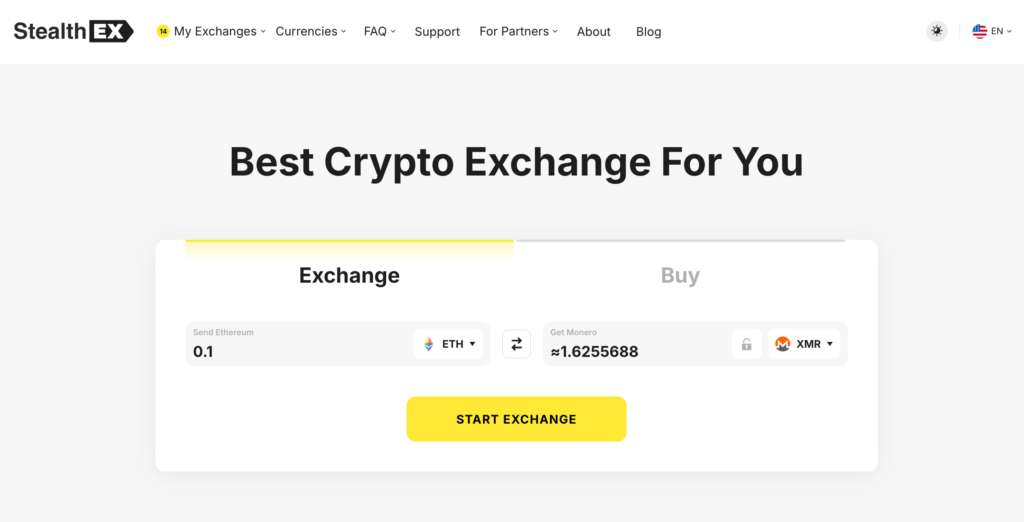
Now, when everything is set, press the Start Exchange button and you will be taken to the next page.
In the second step, you need to provide the Monero recipient address. The recipient address must match the crypto you are going to receive. Remember to double-check the information you enter prior to the exchange as the transaction you make cannot be canceled.
As soon as you have carefully checked all the details, you can press the Next button and you will be redirected to the Confirmation page.
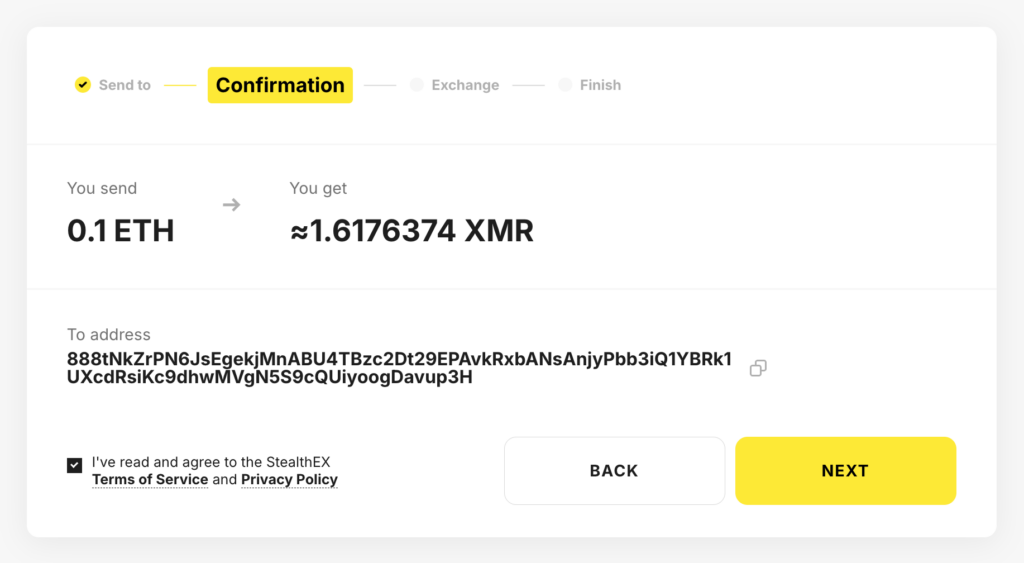
Here you can revise the address provided and the amount of XMR you will receive. Don’t forget to read and check the Terms of Use and Privacy Policy box. Without checking the box you will not be able to continue the exchange.
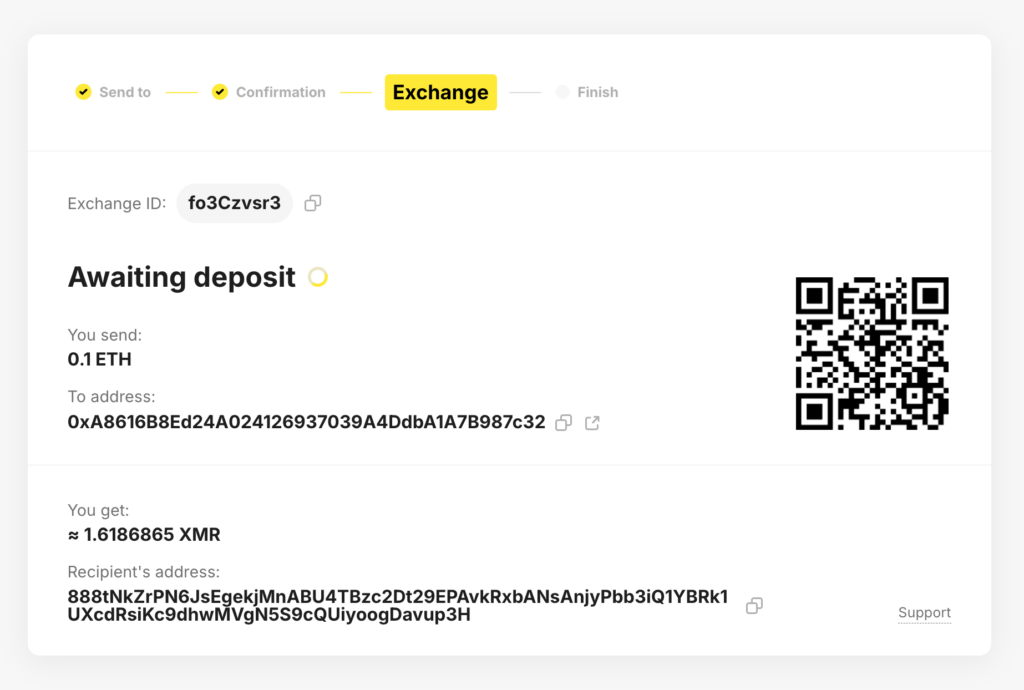
Pressing the Next button you will be redirected to the Exchange page.
At first, you will see the address where you need to send your Ethereum to continue the exchange. StealthEX will also provide you with the exchange ID. It will allow you to keep all the information about the swap. It is recommended to save your exchange ID or the link to your exchange.
XMR Coin Exchange Statuses
After sending ETH coins to the shown address, the information on the Exchange page will be renewed automatically. The Exchange page has several statuses that will change during the time of the exchange.
- The first status is Awaiting deposit.
- The following status is Confirming. This means that StealthEX is confirming the transaction you made.
- The next status is Exchanging. During this time the exchange is being made.
- Then the status will be changed to Sending to your wallet. This indicates that there are just a few minutes until you receive your Monero (XMR).
Finally, you will be redirected to the Finish page. This shows that the exchange has been successfully made and you will receive crypto to the address provided. To be sure that Monero crypto was sent to your wallet you can also use the Output hash shown on this page and check it in the blockchain list of transactions.
From here you can either create a new exchange on StealthEX or leave the page and check your Monero wallet to be surprised at how fast you get XMR sent to your address. Usually, the process is quite rapid so you won’t need to wait long: Monero swaps are processed in a matter of minutes.
Now that we’ve sorted out how you can buy Monero (XMR) via StealthEX, let’s take a closer look at the project and its properties.
Privacy-Focused Crypto with Fungibility
Monero was launched in 2014, 11 years ago, as Bitmonero and initially represented a fork of the codebase of Bytecoin. When Bitcointalk forum user thankful_for_today released Bitmonero, community backers were frustrated over changes that hadn’t taken place. Thankful_for_today was eventually usurped and replaced by volunteers from the community, including a handful of developers who helped maintain and develop the project. Many of them remained pseudonymous.
As one of the few original alternative coins (altcoins) that didn’t rely on Bitcoin’s code, Monero chose not to have a limited supply for XMR. Unlike other privacy coins, it embeds privacy into the protocol rather than making it an optional feature or relying on a second layer to be developed and added later.
Monero (XMR) is an open-source crypto and focuses on anonymity as the main idea behind the project. These blockchains, which are the basic technology behind digital currencies, are public ledgers of participants’ activity that display all network transactions. Monero’s blockchain is purposefully designed to be opaque. It conceals transaction details, such as the identities of senders and recipients and the amount of each transaction, by masking the addresses used by participants.
Monero: Fungible Privacy Beyond Bitcoin
Monero is very different from the oldest and most famous cryptocurrency Bitcoin. Both Bitcoin addresses and transactions are recorded on the blockchain, making them available to the public. Even pseudonymous email addresses are not completely private. A few transactions carried out by a participant over time can be connected to the same address, allowing others to learn about an address owner’s patterns and identity.
Compared to Bitcoin, Monero has fungibility. This means that two units of a currency can be substituted for each other with no difference. While two $1 notes have the same face value, they are not fungible because each has a unique serial number. Two one-ounce gold bars of the same grade, on the other hand, are fungible since they have the same value and no identifying traits. One can say that a Bitcoin is the $1 bill, while a Monero is that piece of gold.
How Does Monero Privacy Work?
Monero’s main privacy feature includes:
- Ring confidential transactions (Ring CTs).
- Stealth addresses.
- Bulletproofs.
- Dandelion ++.
Ring Confidential Transactions
A ring confidential transaction has two components:
- The first is a Multilayered Linkable Spontaneous Anonymous Group (MLSAG) ring signature, which obscures transaction amounts, sources, and destinations.
- The second is confidential transactions, which disguise transaction quantities via a cryptographic mechanism known as the Pedersen commitment.
The Pedersen commitment allows cryptography to be applied to a transaction so that it may be confirmed while only the sender and receiver see the amount being transferred. Ring CTs allow ‘decoy’ coins to be added to transactions, which means the exact amounts are hidden from all but the persons involved. Even with many inputs, the transactions balance out, ensuring that no new Monero coins are created in the process.
Stealth Addresses
Stealth addresses provide Monero users with an additional layer of privacy. For each transaction, stealth addresses generate burner addresses – or one-time public keys – with a sender producing a new address to transfer XMR tokens with a little extra info attached. The owner of the address then uses those bits of data to generate the private keys necessary to access the funds in the address.
Only those engaged are aware that the stealth address matches to the true Monero address. Transactions on the blockchain do not relate back to the actual address because each sender generates a new stealth address. Consider it like contacting someone multiple times with a different phone number each time. Anyone on the outside would have no way of knowing who was phoning and whether it was the same person or not.
Bulletproofs and Dandelion++
Bulletproofs, a system that makes confidential transactions faster and more scalable, were added by Monero in 2018. It reduced the data size of confidential transactions by around 80%, which were fairly big given the decoy coins involved.
In 2020, Monero added Dandelion ++, a feature that hides the IP addresses connected with nodes (computers that help validate the Monero blockchain), reducing the possibility of such identifiable information being used to deanonymize transactions. Dandelion ++ was originally created for Bitcoin but was later ported to Monero. Thanks to it, IP addresses may be used to identify you by internet service providers (ISPs) or virtual network providers (VPNs). It basically selects a proxy node to broadcast from and then broadcasts ‘fluff’ information symmetrically, making it impossible for adversaries to monitor transactions.
Monero’s Potential Use Cases
Most cryptocurrencies show a list of all transactions ever made on a public ledger (the blockchain). Anyone can inspect the wallet that provided them with the funds and evaluate every transaction they have ever performed if they receive Bitcoin, Ethereum, or any other major cryptocurrency. For corporations, this means that their financial assets would be made public, allowing competitors to get critical insights into how much money a company has, when it restocks, and more. Monero enables businesses to send money at any time of day or night, seven days a week, but in private, and this is one of Monero’s potential use cases.
Overall, Monero is a well-known and popular cryptocurrency. As Monero can be mined on low-budget computers using CPUs, hackers have been known to infect unsuspecting website visitor’s computers with malware designed to use their CPU to mine Monero. At the moment, XMR is best known as the currency of the dark web. Some exchanges and tools use it to make their users’ transactions fully anonymous, for instance, HoudiniSwap. Monero’s developers were concerned by the recent Tornado Cash sanctions, however, they remained under the radar.

While at the moment, Monero costs around $210, some experts claim that by 2030, XMR price will rise to $2,100. Since its launch date, Monero has shown extensive growth in the crypto market and has given a great return to its initial investors. While having a controversial reputation, XMR is indeed a popular choice for crypto enthusiasts.
StealthEX offers one of the quickest ways to buy Monero (XMR) effortlessly and without any hassle. It’s simple, it’s safe, and it’s easy!

Make sure to follow StealthEX on Medium, X, Telegram, YouTube, and Publish0x to stay updated about the latest news on StealthEX.io and the rest of the crypto world.
Don’t forget to do your own research before buying any crypto. The views and opinions expressed in this article are solely those of the author.
BTC to XMR how to buy Monero Monero XMR XMRThe post How to Buy Monero: ETH to XMR Swap Guide first appeared on StealthEX.]]>
What Is Monero?
Monero (XMR) is one of the very popular, so-called ‘private’ cryptocurrencies. It is a privacy-oriented and open-source cryptocurrency. It is recognized for its non-transparent structure, fungibility, and accessibility. Monero’s decentralized blockchain has been designed to be private. As a result, it permits obscuring important transaction information including the sender and recipient’s identities as well as the transaction’s total value. In the end, transactions’ anonymity increases blockchain’s security.
In addition to this, Monero is one of the best options when it comes to safety. It leverages the opaque blockchain and makes all the transactions untraceable and anonymous. Monero employs advanced cryptographic techniques to obfuscate transaction details, making it much more difficult to trace transactions and associate them with specific individuals.
Moreover, Monero is fungible, i.e. easily replaceable by an identical item or mutually interchangeable. Therefore, you can easily exchange as well as transact Monero without any problems. The majority of cryptocurrencies are partially fungible. However, the good news is that Monero is completely fungible.
In conclusion, one of the most interesting features of Monero is that it is less volatile than other crypto assets; some even refer to it as being the ‘stable cryptocurrency.’
What Is Bitcoin?
Bitcoin (BTC) is the first and most well-known cryptocurrency, created in 2009 by an anonymous person or group using the pseudonym Satoshi Nakamoto. It operates on a decentralized peer-to-peer network without the need for intermediaries like banks. Bitcoin transactions are recorded on a public ledger called the blockchain, secured through cryptographic techniques. Bitcoin combines its network, cryptocurrency, and blockchain to record transactions transparently, prevent double spending, and ensure consensus via a process called ‘Proof-of-Work.’
Bitcoin has a limited supply of 21 million coins, making it deflationary in nature. Bitcoin’s value is determined by market demand and is known for its price volatility.
Bitcoin is not completely anonymous, it’s pseudonymous. Thus, while Bitcoin transactions are not directly linked to individuals’ identities, the transaction history is stored on a public ledger called the blockchain. This ledger is transparent and can be accessed by anyone. It means that if someone can associate a Bitcoin address with a specific person, they can potentially trace their transaction history.
Monero vs Bitcoin: An Overview
Privacy Features
When it comes to privacy, it is primarily about stealth addresses. These are disorganized, one-time addresses that have nothing to do with any shared or previously put regular addresses. Put simply, on the public ledger, a few transactions sent to the same standard Monero address will appear to have been sent to completely different addresses. The thing is that although you can withdraw the coins that have been deposited to this kind of address, the money is not connected to you in any way. Senders and recipients are the only ones who know the location of XMR transfers. Some crypto platforms, for instance, Houdini Swap, use Monero as a way to make transactions private.
Ring transactions are an additional fantastic privacy feature. It is an amalgam of two excellent privacy technologies: private transactions and ring signatures. The Bitcoin project is underpinned by regular cryptographic signatures, and users validate transactions using their private key, which verifies ownership of the coin that will be spent in a transaction. Ring signatures attest to possession as well, but they also imply an additional degree of uncertainty.
The digital assets used as ‘decoys’ in the same transaction may contain extremely dangerous ones, and it’s unclear which of them were verified. This complicates the process of determining which money was authorized and disbursed. Decoys are blended ten to a set for each transaction. Because of this, Monero is quite challenging to follow.
However, Bitcoin has also made steps towards privacy. For example, certain wallets based on Bitcoin, such as Samourai Wallet, recommend optional stealth addresses. Another feature that mixes coins is called ZeroLink. This makes it difficult to determine who is the true owner of the coins and where they came from.
Mining Features
The ‘Proof-of-Work mining’ theory underpins the operation of both tokens. What is entered into a ledger is approved by the participants or miners. These men use their hardware in a rush to solve mathematical equations. If someone had been ahead, they would have been rewarded with fresh Bitcoin or XMR and their unique block would have been added to the network.
Different mining protocols are used by Bitcoin and Monero projects. The SHA-256 algorithm used by Bitcoin runs on hardware known as application-specific integrated circuits (ASICs). They are made especially for mining Bitcoin and are highly expensive. These days, mining on a PC is pointless because ASIC users offer fierce competition.
Success is clearly on the side of those who own ASICS. However, they use a lot of energy and are not very cheap. Because of this, mining Bitcoins in places with cheap electricity is now a decentralized operation. This method of obtaining Bitcoin appears hard to the average person.
Scalability
The project’s scalability is determined by how many transactions it can process in a second. This is also a crucial component for success in the field. Another aspect that we may evaluate between XMR and BTC is scalability, or the capacity to manage large volumes of transactions. Unfortunately, both businesses struggled to meet the high demand during the crypto boom in 2017.
Both saw a sharp increase in the average transaction commission, indicating that they were not prepared for regular use. Transaction commissions were significantly greater than those of low-commission payment methods (such as credit cards, PayPal, Venmo, and Venmo), even if they might have been more or less equal to bank transfer commissions.
But in this case, Bitcoin wins since Monero lacks the necessary expertise to handle thousands of transactions every day. Bitcoin is currently processing hundreds of thousands of transactions every day. As of right now, Monero is unable to compete with large payment networks because its small transaction volume has already caused scalability concerns.
Regulatory Issues
While Bitcoin has been accepted by many governments and countries all around the world, Monero is struggling under legal pressure. The potential of privacy coins for illicit operations, like money laundering and tax evasion, has alarmed governments and financial regulators around the world.
These concerns have led to increased regulatory scrutiny and in some cases, forced cryptocurrency exchanges to delist Monero and other privacy coins. Delisting might reduce Monero’s liquidity and accessibility, making it more difficult for consumers to purchase, exchange, and use the cryptocurrency. This hinders uptake and lessens Monero’s prospects of success in the already fiercely competitive cryptocurrency space.
Meanwhile, Bitcoin has even made it to become a legal tender: El Salvador became the first country to make bitcoin legal tender; not only must Bitcoin be accepted as a means of payment for taxes and debts, but also businesses are required to accept BTC as a medium of exchange.
Monero vs Bitcoin – Key Differences Between XMR and BTC
Monero (XMR) and Bitcoin (BTC) are both very popular assets within the crypto industry, but they have distinct features and capabilities. Here’s a breakdown of the key differences between these two projects:
- Transaction speed – Monero’s shorter block times result in faster transactions compared to Bitcoin’s longer confirmation times.
- Fees – Monero generally provides lower and more predictable fees due to dynamic block size adjustments, whereas Bitcoin fees can vary widely.
- Scalability – Monero has more promising scalability prospects, with dynamic block size and ongoing efforts to enhance scalability, while Bitcoin constantly battles with scalability issues.
- Mining – Monero employs an ASIC-resistant RandomX algorithm for CPU/GPU mining, fostering decentralization, whereas Bitcoin’s SHA-256 algorithm is dominated by ASICs.
- Privacy – Monero gives its users the ultimate privacy features by making transactions challenging to trace, while Bitcoin’s transactions are pseudonymous, with a number of privacy BTCutions.
- Development – Monero boasts an active development community with a focus on privacy and security improvements, while Bitcoin primarily serves as a digital store of value.
- Different goals – Bitcoin focuses on providing a decentralized, transparent, and secure means of transferring and storing value, and Monero prioritizes privacy and fungibility, aiming to make transactions as anonymous and indistinguishable as possible.
Choose StealthEX for Exchange and Buy Crypto
- User-Friendly — Simple and minimalistic interface for everyone.
- Fast and Private — Instant non-custodial cryptocurrency exchanges.
- Buy crypto with Credit Card.
- 2,000+ coins and tokens are available for limitless, quick and easy exchanges.
- NO-KYC crypto exchanges — Buy cryptocurrency up to $700 without KYC!
- StealthEX crypto exchange app — Process crypto swaps at the best rates wherever you are.
- 24/7 Customer Support.
Earn from Each Exchange by Joining StealthEX Affiliate Program.
Become a partner right now and use affiliate tools:
- Public API — Earn from your wallet, aggregator, or exchange terminal.
- Referral Links — Recommend StealthEX to your audience.
- Exchange Widget — Built crypto exchange widget on any page of your website.
- Button — A perfect choice for traffic monetization.
- Banner — Track conversion and stats right in the personal cabinet.
Monero vs Bitcoin – Key Similarities Between XMR and BTC
While Monero (XMR) and Bitcoin (BTC) have their unique features, they also share several key similarities. Let’s take a look at what brings these two major players in the industry closer:
- Consensus Mechanism – Both platforms use the PoW (Proof-of-Work) consensus mechanism.
- Cryptocurrency Tokens – XMR and BTC are the native cryptocurrencies of Monero and Bitcoin, respectively. These tokens are used for transactions, network fees, and participating in governance.
- Blockchain technology – Both Monero and Bitcoin are built on blockchain technology. They offer decentralized BTCutions, moving away from traditional centralized systems.
- Global Reach – Monero and Bitcoin have a global user base. They aim to provide blockchain solutions across various industries worldwide.
In essence, Monero and Bitcoin, despite their differences, are important bricks in today’s crypto industry’s foundation, serving as means of storing value and transferring payments.
Monero vs Bitcoin – Comparison Table
| Feature | Monero (XMR) | Bitcoin (BTC) |
| Year of Creation | 2014 | 2009 |
| Purpose | Digital currency and store of value | Conducting censorship-resistant transactions |
| Consensus Mechanism | Proof-of-Work | Proof-of-Work |
| Transaction Speed | ~6 transactions per second | ~7 transactions per second |
| Supply Limit | Capped at 18.4 million XMR | Capped at 21 million BTC |
| Block Time | ~2 minutes per block | ~10 minutes per block |
| Development Approach | Maintains egalitarian mining, so that everyone can have the possibility to mine | Allows for neutrality towards developers, users, and miners |
| Technology Base | Blockchain | Blockchain |
| Native Cryptocurrency | XMR | BTC |
| Governance | Sovereign-grade censorship-resistance | On-chain governance |
| Popularity | The most private coin on the market | The first and most well-known cryptocurrency |
| Global Reach | Worldwide user base, diverse applications | Worldwide user base, diverse applications |
Future Outlook on XMR and BTC
Because of its many wallet alternatives, accessibility throughout the world, and increasing institutional interest, Bitcoin has become more widely accepted and is currently accepted as payment by a number of well-known companies. The Lightning Network also enhances its utility for everyday transactions.
However, Monero’s main advantage is its strong privacy features, which guarantee both transaction anonymity and user security. But these very characteristics also add to its regulatory issues because of worries about compliance and anonymity, as well as its public perception issue because it is frequently linked to illegal activity.
While both cryptocurrencies have a huge potential, the crypto landscape is always subject to change, so the pendulum can swing, making one of these assets more sought-after. Moreover, crypto volatility can shrink any potential investments in both XMR and BTC, making this a risky option for traditional investors. As with any investment, it’s best to do your own research and stay updated about regulatory changes in the crypto environment.
Summary
Both Bitcoin and Monero are different cryptocurrency strategies, each with its own special characteristics and advantages. Being the first cryptocurrency, Bitcoin provides visibility, liquidity, and a value store comparable to digital gold. Because of its transparency, auditability and regulatory compliance are made possible in addition to financial traceability.
However, Monero puts privacy first, offering users the highest level of transaction confidentiality and anonymity. Because all currencies are equal thanks to their fungibility, there is less reason to worry about tainted cash. The goal of financial security and anonymity is something that Monero’s community actively supports.
In the end, it’s up to you to decide how XMR or BTC aligns with your personal investment goals. However, should you wish to buy either of these popular cryptocurrencies, check out StealthEX, your ultimate instant exchange where you will be able to buy not only Monero and Bitcoin, but also a variety of other cryptocurrencies – safely, quickly, and easily.
Follow us on Medium, X, Telegram, YouTube, and Publish0x to stay updated about the latest news on StealthEX.io and the rest of the crypto world.
This article is not supposed to provide financial advice. Digital assets are risky. Be sure to do your own research and consult your financial advisor before investing.
Bitcoin BTC to XMR cryptocurrency Monero privacy coinsThe post Monero vs Bitcoin: What Are the Main Differences? The Ultimate Comparison first appeared on StealthEX.]]>
The “Under $1” category is compelling because it offers an accessible entry point into projects with strong fundamentals and a clear vision for the future. As institutional adoption grows and blockchains process more transactions than ever, many of these platforms are positioned for significant growth.
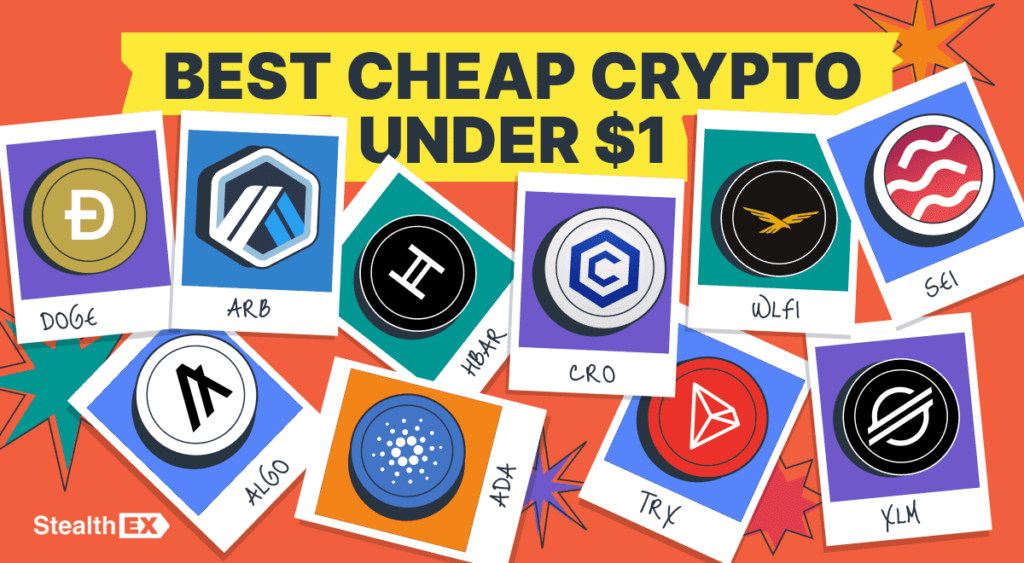
This article will analyze 10 notable cryptocurrencies trading under $1 that have compelling catalysts making them worth watching in 2025. We’ll explore their technology, use cases, and the risks you need to consider.
The Top 10 Cheap Crypto Under $1
From the original meme coin to powerhouse enterprise solutions, this list showcases the diversity and potential of the sub-one-dollar crypto market.
Dogecoin (DOGE)
The original meme coin, Dogecoin, is a decentralized, peer-to-peer digital currency that enables online transactions. What started as a joke has evolved into a crypto mainstay with one of the most powerful and recognizable communities.
The price of 1 DOGE is currently around $0.2.
- Why DOGE? Dogecoin’s strength lies in its simplicity and massive brand recognition. With ongoing discussions about its potential integration into X (formerly Twitter) for payments and a passionate community that consistently drives its relevance, DOGE remains a cultural and financial force.
- Key Differentiators: Unparalleled brand awareness and a massive, highly active community. Its proof-of-work consensus is simple and proven.
- Potential Risks: Its development is slower than many other projects, and its value is heavily influenced by social media trends and celebrity endorsements, leading to extreme volatility.
Cardano (ADA)
Cardano is a proof-of-stake blockchain platform with a mission to provide a more secure and sustainable ecosystem for decentralized applications (dApps). It is known for its research-driven, peer-reviewed development methodology.
The price of 1 ADA is currently around $0.65.
- Why ADA? The 2025 crypto market is prioritizing energy-efficient and scalable solutions, placing Cardano in a strong position. Its ecosystem of dApps is steadily growing, and its focus on scalability and governance continues to attract developers. Despite being ranked lower than some competitors in specific metrics, it maintains a top-tier overall market ranking, underscoring its large valuation and investor confidence.
- Key Differentiators: An academic, research-first approach to development. A strong focus on sustainability and a clear roadmap for on-chain governance.
- Potential Risks: Its methodical, peer-reviewed approach means development can be slower than competitors. It faces intense competition from other Layer-1 blockchains.
Algorand (ALGO)
Algorand is a high-performance blockchain platform founded by Turing Award-winning cryptographer Silvio Micali. It utilizes a unique “Pure Proof-of-Stake” (PPoS) consensus mechanism to deliver fast, low-cost, and scalable transactions.
The price of 1 ALGO is currently around $0.19.
- Why ALGO? Algorand is built for the world of institutional finance. Its carbon-neutral status, high throughput, and immediate transaction finality make it an attractive platform for DeFi, digital securities, and central bank digital currencies (CBDCs). As traditional finance continues to merge with crypto, Algorand’s enterprise-grade infrastructure is poised for adoption.
- Key Differentiators: Its PPoS mechanism solves the “blockchain trilemma” (security, scalability, decentralization) in a unique way. It boasts institutional-grade performance and a carbon-neutral footprint.
- Potential Risks: While technologically advanced, it has struggled to gain the same level of developer and user adoption as chains like Ethereum or Solana.
Stellar (XLM)
Stellar is an open network designed to connect financial institutions and provide cheap, fast, cross-border transactions for both fiat currencies and digital assets. Its primary goal is to bank the unbanked and streamline global payments.
The price of 1 XLM is currently around $0.33.
- Why XLM? Stellar is optimized for its core purpose: payments. Its growing utility is highlighted by the surging supply of stablecoins on its network. Furthermore, its ability to facilitate real-world asset (RWA) tokenization bridges the gap between traditional finance and blockchain, making it a key player for the future of finance.
- Key Differentiators: Focus on fast, low-cost cross-border payments and remittances. Long-standing partnerships with financial institutions and tech companies.
- Potential Risks: It faces stiff competition from other payment-focused projects like Ripple (XRP) and the rise of stablecoins on more generalized blockchains.
Arbitrum (ARB)

Arbitrum is a leading Layer-2 (L2) scaling solution for Ethereum. It bundles transactions off-chain, processes them, and then posts the results back to the Ethereum mainnet, allowing users to benefit from Ethereum’s security with much lower fees and higher speeds.
The price of 1 ARB is currently around $0.33.
- Why ARB? As Ethereum continues to be the dominant smart contract platform, the need for effective scaling solutions like Arbitrum is critical. It hosts a vibrant and growing ecosystem of DeFi and gaming applications. Analysts identify it as a leading project in L2 scaling, with a strong outlook for future growth and adoption in the push for a more scalable crypto infrastructure.
- Key Differentiators: Full compatibility with the Ethereum Virtual Machine (EVM), a massive and active ecosystem, and a clear lead in Layer-2 adoption metrics.
- Potential Risks: It faces intense competition from a growing number of other Layer-2 solutions. Its current ranking is below some Layer-1s like Cardano, indicating it still has ground to gain in overall market valuation.
Hedera (HBAR)

Hedera is not a traditional blockchain but a public network that uses a “hashgraph” consensus mechanism. It aims to provide a faster, fairer, and more secure platform for decentralized applications.
The price of 1 HBAR is currently around $0.17.
- Why HBAR? Hedera is built for enterprise adoption. Its unique governance model, a council that includes giants like Google and IBM, positions it as a reliable and scalable network for serious business applications. The growing demand for stablecoins and enterprise-grade hashgraph adoption are key growth drivers for 2025, making HBAR a standout project.
- Key Differentiators: The hashgraph consensus mechanism offers incredibly high speeds and low-cost transactions. Its governance by a council of world-leading organizations provides unparalleled credibility.
- Potential Risks: The hashgraph technology is more complex and less understood than blockchain. The governing council model raises concerns about potential centralization compared to fully open-source projects.
Tron (TRX)
Tron is a high-throughput blockchain designed to host large-scale decentralized applications. It has become one of the most popular networks for stablecoin transfers, particularly for USDT.
The price of 1 TRX is currently around $0.33.
- Why TRX? As stablecoins power trillions of dollars in annual transaction volume, rivaling payment giants like Visa, the platforms that facilitate these transfers are critical. Tron’s low transaction fees and high speed have made it a go-to choice for moving stablecoins, giving it a powerful and persistent use case.
- Key Differentiators: Extremely high transaction throughput and very low fees. Dominant market share in USDT stablecoin transfers.
- Potential Risks: The project faces persistent concerns about the degree of its decentralization and has been the subject of regulatory scrutiny in the past.
Sei (SEI)

Sei is a Layer-1 blockchain specifically optimized for trading. It features a built-in order-matching engine at its core, designed to give decentralized crypto exchanges (DEXs) a speed and efficiency advantage that mimics centralized exchanges.
The price of 1 SEI is currently around $0.2.
- Why SEI? While other blockchains are general-purpose, Sei is purpose-built for one thing: trading. This specialization could give it a significant edge in attracting DEXs and high-frequency trading applications looking for the best possible performance. Its claim to be the fastest chain to finality is a major draw for the DeFi sector.
- Key Differentiators: Industry-specific focus on trading. A built-in native order book for superior DEX performance.
- Potential Risks: Its narrow focus means it may not attract the wide variety of dApps that general-purpose chains do. It must prove its performance is a significant enough advantage to pull liquidity from established ecosystems.
Cronos (CRO)
Cronos is the EVM-compatible blockchain of the massive Crypto.com ecosystem. It runs parallel to the Crypto.org Chain and is designed to scale the DeFi and dApp ecosystem by allowing developers to port apps from Ethereum easily.
The price of 1 CRO is currently around $0.15.
- Why CRO? The success of CRO is tied to the growth of its parent company, Crypto.com. Recent developments show a strong push into institutional adoption, with a Cronos partnership with Amazon Web Services (AWS) to accelerate real-world asset (RWA) tokenization and derivatives licensing from the CFTC in the US.
- Key Differentiators: Backed by a major global crypto exchange. Full EVM compatibility makes it easy for developers to build and migrate applications.
- Potential Risks: The value and adoption of CRO are heavily dependent on the business performance, strategy, and reputation of Crypto.com.
World Liberty Financial (WLFI)

World Liberty Financial is a less-established project aiming to create a suite of decentralized financial services. Its goals include offering solutions for digital banking, payments, and financial freedom through its blockchain-based platform.
The price of 1 WLFI is currently around $0.15.
- Why WLFI? As a smaller-cap project, WLFI represents a higher-risk, higher-potential-reward investment. Its broad ambition to tackle decentralized finance puts it in a competitive space, but success in even one area could lead to significant growth. It’s a project for investors looking for ground-floor opportunities.
- Key Differentiators: An ambitious all-in-one vision for decentralized financial services, from banking to lending.
- Potential Risks: As a smaller project, it faces significant risks related to liquidity, adoption, and execution. Its goals are very ambitious, and it competes with hundreds of more established DeFi projects. Thorough personal research is absolutely critical.
How to Buy Cheap Crypto on StealthEX?
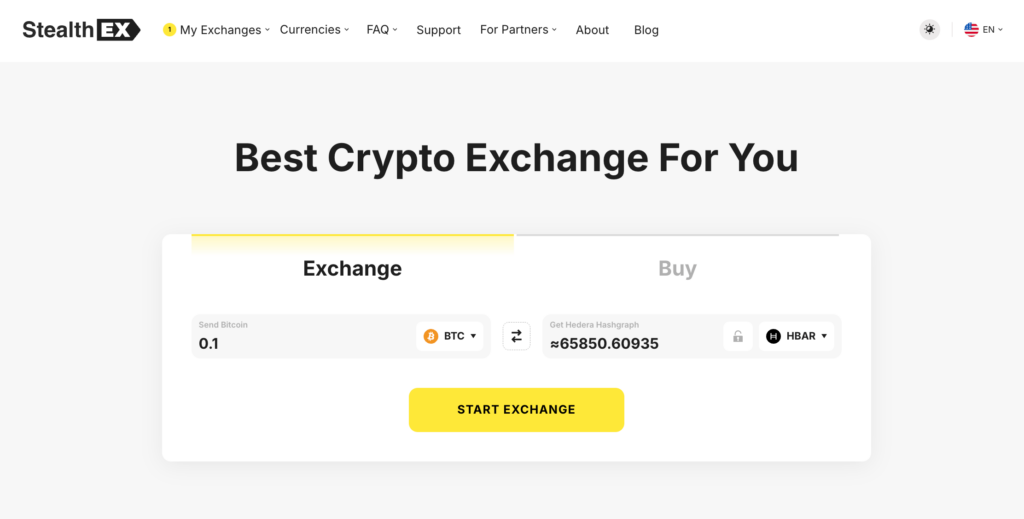
Ready to add one of these promising sub-$1 assets to your portfolio? StealthEX provides a straightforward and secure way to acquire them without lengthy sign-ups or entrusting your funds to a third party. Here’s the simple, non-custodial process:
- Go to StealthEX.io.
- Select the pair you want to exchange from the dropdown lists (e.g., BTC for HBAR).
- Enter the amount you want to swap.
- Provide your recipient wallet address (the one where you want your new coins to go).
- Check the details, send your initial crypto to the address provided, and StealthEX will automatically handle the swap. Your new coins will be sent directly to your wallet.
Low-Cost Cryptocurrency: A Market of Fundamentals and Opportunity
The “Under $1” crypto category is far more than just a collection of cheap tokens. It represents a diverse landscape of innovation, from established Layer-1s like Cardano and Algorand to critical infrastructure like Arbitrum and enterprise-focused networks like Hedera.
While the low price point is attractive, it does not mean low risk. The fundamentals, technology, community, and the specific problems a project solves are what truly matter. Always do your own research to understand the assets you are investing in. By staying informed, you can confidently explore the rich opportunities in this exciting segment of the crypto market.
This article is for informational purposes only and does not constitute financial or investment advice. The cryptocurrency market is extremely volatile and carries a high degree of risk. Always conduct your own thorough research and consult a qualified financial advisor before making any investment decisions.
Follow us on Medium, X, Telegram, YouTube, and Publish0x to stay updated about the latest news on StealthEX and the rest of the crypto world.
Algorand buy crypto cheap crypto Cronos invest in cryptoThe post What Is the Best Cheap Crypto to Buy Right Now? Under $1 first appeared on StealthEX.]]>
But what is a cheap crypto? It’s important to understand that a low price per coin doesn’t necessarily mean a project has a low valuation. It simply means the entry cost per token is affordable. Еhe landscape is currently more interesting than ever. We’re seeing meme coins evolve beyond jokes into full-fledged ecosystems, while other projects are quietly building utility for real-world industries.

This article will explore 10 promising low-cost cryptocurrencies to watch right now. We’ll dive into what makes them unique, their potential for growth, and the risks you must consider.
The Top 10 Cheap Crypto for Your Watchlist
Here are ten projects trading under $0.1 that are making waves for different reasons, from viral community strength to groundbreaking technology.
Shiba Inu (SHIB)

Originally launched as a direct competitor to Dogecoin, Shiba Inu has grown from a simple meme coin into a vast ecosystem. Its goal is to create a decentralized community-run platform with applications in DeFi, NFTs, and the metaverse.
The price of 1 SHIB is about $0.00001 now.
- Why SHIB? Shiba Inu’s biggest evolution is Shibarium, its own Layer-2 blockchain designed to provide faster, cheaper transactions for its ecosystem. This move signals a serious shift from hype to utility, which could attract new developers and users. Despite recent market dips, SHIB remains a major player with a massive, loyal community still watching for the next rally].
- Key Differentiators: A three-token ecosystem (SHIB, LEASH, BONE), a dedicated Layer-2 network, and one of the most recognizable brands in crypto.
- Potential Risks: High token supply creates significant inflationary pressure. The project’s success is still heavily tied to community sentiment and market hype.
Pepe (PEPE)

PEPE is a purely cultural meme coin built on Ethereum, capitalizing on the long-standing popularity of the “Pepe the Frog” internet meme. It was launched with no presale, zero taxes, and a burnt liquidity pool to appeal to the crypto community.
The price of 1 PEPE is about $0.000007 now.
- Why PEPE? PEPE demonstrated the raw power of meme culture by reaching a $1 billion market cap in record time. Its strength lies in its simplicity and deep cultural roots. For 2025, analysts see it as a top contender in the meme coin space, battling for dominance and investor attention. It represents a bet on the continued relevance of internet culture in crypto.
- Key Differentiators: No intrinsic utility or formal team, which is presented as a feature, it is purely a “memetic” asset. Its brand recognition is arguably second only to dog-themed coins.
- Potential Risks: The lack of a roadmap or utility makes PEPE extremely speculative and dependent on social media trends. It is highly volatile.
Bonk (BONK)

BONK claims the title of the first dog-themed meme coin on the Solana blockchain. It was initially airdropped to the Solana community to boost morale and liquidity across the ecosystem’s decentralized exchanges (DEXs).
The price of 1 BONK is about $0.000015 now.
- Why BONK? Unlike many meme coins, BONK is deeply integrated into the Solana ecosystem. It’s used in dozens of dApps for everything from NFT minting to DeFi staking. This utility gives it a stickiness that other hype-driven coins lack. As a result, it’s often hailed alongside other newer tokens as one of the next potential big winners.
- Key Differentiators: Solana-native, providing speed and low fees. Widespread integration across Solana dApps gives it genuine use cases within its ecosystem.
- Potential Risks: Its fate is closely tied to the performance and adoption of the Solana blockchain. It faces fierce competition from a constant stream of new Solana-based meme coins.
FLOKI (FLOKI)

Named after Elon Musk’s Shiba Inu dog, FLOKI has aggressively pursued a strategy of “meme plus utility.” It aims to be a comprehensive Web3 ecosystem encompassing DeFi, NFTs, and a metaverse known as Valhalla.
The price of 1 FLOKI is about $0.00007 now.
- Why FLOKI? FLOKI has successfully transitioned from being just another dog coin to a project with tangible products. Its play-to-earn NFT metaverse game, Valhalla, DeFi staking/lending offerings, and crypto education platform demonstrate a commitment to long-term value. This dedication to building has put it on the radar as a top meme coin to watch for the future.
- Key Differentiators: A strong focus on building a utility-rich ecosystem. Valhalla is its flagship product, aiming to bring mainstream gaming to the blockchain.
- Potential Risks: The success of its ecosystem depends on its ability to attract and retain a large user base for its products, which is a significant challenge in the competitive Web3 space.
Pump.fun (PUMP)

Pump.fun is not a single cryptocurrency but a revolutionary platform on Solana that allows anyone to create and launch a new meme coin in seconds for a minimal fee. Tokens launched here trade on a “bonding curve” until they reach a certain market cap, at which point liquidity is automatically deployed to the Raydium DEX.
The price of 1 PUMP is about $0.004 now.
- Why PUMP? Pump.fun represents a major trend: the “memecoin factory.” It has democratized token creation, leading to thousands of new coins daily. Understanding this platform is key to understanding the modern meme coin landscape. Its emergence is a significant development that traders are watching closely.
- Key Differentiators: Instant, low-cost token deployment. It has a built-in mechanism to prevent “rug pulls” before a token moves to a major DEX, though risks remain.
- Potential Risks: The vast majority of tokens launched on Pump.fun fail or are outright scams. It is an environment of extreme speculation. The platform itself is centralized, posing a single point of failure. Investing in tokens from this platform is exceptionally high-risk.
JasmyCoin (JASMY)

Often called “Japan’s Bitcoin,” JasmyCoin is a Tokyo-based project focused on data democracy and the Internet of Things (IoT). Its goal is to give individuals sovereignty over their own data, allowing them to securely store it and monetize it if they choose.
The price of 1 JASMY is about $0.01 now.
- Why JASMY? As our world becomes more connected with smart devices, the issue of data privacy and ownership becomes more critical. Jasmy’s focus on this niche is timely. Its compliance with strict Japanese regulations gives it a degree of legitimacy that many crypto projects lack.
- Key Differentiators: A clear focus on the IoT and personal data markets. Strong geographic positioning within Japan’s regulated tech landscape.
- Potential Risks: The project’s goals are highly ambitious and depend on widespread adoption by both device manufacturers and consumers. It faces competition from traditional Big Tech companies.
VeChain (VET)

VeChain is a blockchain platform designed to enhance supply chain management and business processes. Its goal is to provide enterprises with a secure and transparent way to track products from factory to final consumer.
The price of 1 VET is about $0.02 now.
- Why VET? Sustainability and supply chain transparency are growing priorities for global businesses. VeChain is already established in this sector with partnerships that include Walmart China, BMW, and H&M. As companies face more pressure to prove the authenticity and ethical sourcing of their goods, VeChain’s solutions become increasingly relevant.
- Key Differentiators: A proven track record with real-world, enterprise-level partnerships. A two-token system (VET and VTHO) separates the investment asset from the “gas” token used for transactions, creating a more predictable cost model for businesses.
- Potential Risks: Widespread enterprise adoption of blockchain is slow. It operates in a competitive space with other enterprise-focused solutions, including traditional non-blockchain systems.
Kaspa (KAS)

Kaspa is a proof-of-work cryptocurrency that claims to be the fastest and most scalable Layer-1 project of its kind. Instead of a traditional blockchain, it uses a revolutionary “blockDAG” structure (a mathematical structure called a GHOSTDAG protocol).
The price of 1 KAS is about $0.06 now.
- Why KAS? Kaspa’s technology allows it to process multiple blocks simultaneously, enabling extremely fast transaction finality (currently around 10 seconds). For enthusiasts of pure, decentralized, proof-of-work digital cash—similar to Bitcoin’s original vision but with modern speed—Kaspa is a project of immense interest.
- Key Differentiators: The blockDAG architecture is a major technological departure from standard blockchains, offering high throughput without sacrificing decentralization.
- Potential Risks: As a proof-of-work coin, it is energy-intensive. It is still a relatively new technology, and its ecosystem of dApps and developers is much smaller than that of established blockchains like Ethereum or Solana.
XDC Network (XDC)

The XDC Network is a hybrid blockchain designed to modernize the global trade and finance industry. It combines the speed and security of private networks with the transparency of public ledgers, making it suitable for enterprise and institutional use cases.
The price of 1 XDC is about $0.065 now.
- Why XDC? The trade finance industry is worth trillions of dollars and is notoriously inefficient. XDC is positioning itself as a key solution for tokenizing assets, streamlining cross-border transactions, and improving capital efficiency for financial institutions. Its compatibility with the Ethereum Virtual Machine (EVM) makes it easy for developers to build on.
- Key Differentiators: A hybrid blockchain architecture specifically tailored for regulated industries. A strong focus on the massive trade finance market.
- Potential Risks: The adoption cycle in the finance industry is very long and fraught with regulatory hurdles. It faces competition from other enterprise-grade blockchains like Ripple (XRP) and Stellar (XLM).
Beldex (BDX)

Beldex is a privacy-focused crypto ecosystem. Going beyond just a private cryptocurrency, Beldex is building a suite of decentralized, privacy-preserving applications (dApps), including a private messenger (BChat), a decentralized VPN (BelNet), and a private web browser.
The price of 1 BDX is about $0.08 now.
- Why BDX? In an age of increasing digital surveillance, the demand for privacy is a powerful narrative. Beldex offers a comprehensive solution rather than just an anonymous transaction coin. Its plan to transition to a proof-of-stake model will also introduce masternodes, offering users a way to earn rewards for securing the network.
- Key Differentiators: An entire ecosystem of privacy-centric dApps. A clear roadmap for building out its Web3 privacy suite.
- Potential Risks: Privacy coins face intense regulatory scrutiny globally, with some exchanges delisting them. The success of the project relies on its ability to build a user base for its dApps, which must compete with established, non-private alternatives.
How to Buy Penny Crypto on StealthEX?
Inspired to add one of these low-cost assets to your portfolio? StealthEX offers a simple and secure way to buy them without complicated sign-ups. As a non-custodial exchange, you are always in control of your crypto. Here’s how it works:
- Go to StealthEX.
- Select the pair you want to exchange from the dropdown lists (e.g., BTC to SHIB).
- Enter the amount you wish to swap.
- Provide the wallet address where you want to receive your new coins.
- Confirm the details, send your initial funds to the address provided, and let StealthEX handle the rest. Your new crypto will arrive in your wallet shortly.

Cheap Crypto: Opportunity and Caution
The world of low-cost crypto is filled with exciting possibilities. From meme coins building real utility like Shiba Inu and FLOKI to specialized projects like VeChain and Kaspa tackling real-world problems, there is no shortage of innovation.
However, the potential for high rewards always comes with high risk. These assets are volatile, and their prices can change dramatically. The key is to do your own research, understand the project you’re investing in, and never invest more than you are willing to lose. By staying informed, you can navigate this thrilling corner of the market with confidence.
This article is for informational purposes only and should not be considered financial or investment advice. The cryptocurrency market is highly volatile and speculative. Please conduct your own thorough research and consult with a qualified financial advisor before making any investment decisions.
Follow us on Medium, Twitter, Telegram, YouTube, and Publish0x to stay updated about the latest news on StealthEX and the rest of the crypto world.
BONK cheap crypto PEPE Pump.fun SHIBThe post What Is the Best Cheap Crypto to Buy Now? Under $0.1 first appeared on StealthEX.]]>
| Current ZRC Price | ZRC Prediction 2025 | ZRC Price Prediction 2030 |
| $0.0335 | $0.05 | $0.12 |

Zircuit (ZRC) Overview
Zircuit is an AI-powered chain for secure, automated finance. Designed as a hybrid ZK-Optimistic rollup, Zircuit leverages Ethereum’s security while optimizing performance through advanced proof aggregation and parallel processing. Its standout feature, Sequencer-Level Security (SLS), utilizes AI to detect and block malicious transactions in real-time, claiming to prevent 99.5% of hacks, phishing, and exploits. The platform supports institutional-grade features like customizable transaction policies (e.g., KYC, allowlists) and has attracted over $3.4B in TVL during its testnet phase, backed by investors like Binance Labs and Pantera Capital.
ZRC is the native utility and governance token of Zircuit, and it serves as the backbone for transactions, staking, governance, and ecosystem incentives within the Zircuit network. Designed to align with the platform’s hybrid rollup architecture, ZRC combines security, scalability, and AI-driven functionality.
ZRC Price Statistics
| Current Price | $0.0335 |
| Market Cap | $73,185,893 |
| Volume (24h) | $43,913,926 |
| Market Rank | #442 |
| Circulating Supply | 2,194,923,458 ZRC |
| Total Supply | 10,000,000,000 ZRC |
| 1 Month High / Low | $0.0505 / $0.0222 |
| All-Time High | $0.1379 Nov 25, 2024 |
The project was established by a team of web3 security veterans and researchers, including co-founders Martin Derka, Krishna Sriram, and Jan Gorzny. It was initially founded in 2022 and officially launched its mainnet on August 5, 2024, marking a significant milestone in its development as an AI-powered, EVM-compatible ZK rollup.
Zircuit Features
Zircuit offers several features within the crypto space:
- AI-Powered Sequencer-Level Security (SLS): Zircuit introduces a breakthrough security system that uses AI to monitor and block malicious transactions at the sequencer level. This means developers can build applications with confidence, knowing that 99.5% of potential hacks, phishing attempts, and exploits will be automatically intercepted before they can affect users.
- Hybrid Architecture: Zircuit combines the best aspects of zero-knowledge proofs and optimistic rollups to create a unique scaling solution. This means Ethereum developers can deploy existing dApps without modifications while benefiting from ZK-proof security and Optimistic Rollup efficiency, achieving both high throughput and low costs.
- Cross-Chain AI Trading Engine: Zircuit’s Hyperliquid platform provides an AI-driven trading infrastructure that spans multiple blockchains. This means traders can access liquidity across 120+ chains with automated risk detection and optimal execution, all protected by Zircuit’s secured vault system.
- Research-Backed Blockchain Innovation: Zircuit’s technology is built on peer-reviewed research. This means every component, from its proof aggregation system to its formal verification methods, has undergone rigorous academic scrutiny, ensuring mathematically-proven security and efficiency.
ZRC Price Chart

CoinGecko, August 6, 2025
Zircuit Price History Highlights
- 2024: Zircuit mainnet launched on August 5, 2024. Its native token, ZRC, shot to its all-time high of $0.1379 on November 25.
- 2025: In July, ZRC crypto went as high as $0.05. At the moment, its price hovers between $0.03 and $0.04.
Zircuit Price Prediction: 2025, 2026, 2030
| Year | Minimum Price | Maximum Price | Average Price | Price Change |
| 2025 | $0.023 | $0.073 | $0.05 | +50% |
| 2026 | $0.025 | $0.092 | $0.06 | +80% |
| 2030 | $0.05 | $0.19 | $0.12 | +260% |
ZRC Coin Price Prediction 2025
DigitalCoinPrice crypto experts think that in 2025, ZRC coin could reach a maximum of $0.0734 (+120%), with a potential low of $0.0299 (-10%).
Meanwhile, CoinCodex analysts project a more pessimistic scenario, estimating a minimum price of $0.023039 (-30%) and a peak of $0.025516 (-25%), reflecting high volatility of the cryptocurrency and the unpredictability of the market.
Zircuit Price Prediction 2026
DigitalCoinPrice experts think that in 2026, the ZRC token will cost as much as $0.0856 (+155%) per coin at its highest point. According to them, it will also cost no less than $0.0718 (+115%).
CoinCodex projects a potential bullish surge to $0.092437 (+175%), contingent on sustained adoption of Zircuit’s AI-powered trading engine and institutional inflows into its $950M Deposit Vaults. Their baseline scenario of $0.025249 (-25%) accounts for short-term volatility.
CoinLore forecasts a higher floor of $0.0571 (+70%), with upside to $0.0607 (+80%), pointing to product launches and institutional demand.
ZRC Price Prediction 2030
By 2030, DigitalCoinPrice projects Zircuit coin could surge to $0.18 (+435%), with a conservative floor of $0.16 (+375%), reflecting strong confidence in its long-term growth potential.
CoinCodex presents a more cautious forecast, estimating a peak of $0.143623 (+330%) and a baseline of $0.071515 (+115%), accounting for potential market volatility and resistance levels.
Meanwhile, CoinLore offers an even more bullish scenario, predicting ZRC could reach $0.1907 (+470%) at its highest, though it warns of potential dips to $0.0506 (+50%), highlighting the asset’s sensitivity to macroeconomic trends and adoption milestones.
Zircuit Price Prediction: What Do Experts Say?
Zircuit initially established itself as a secure on-chain banking solution through its Deposit Vaults, which now safeguard over $950 million in assets, including stablecoins, ETH, and BTC. In 2025, Zircuit expanded its financial toolkit with the launch of its AI-powered trading engine, dubbed Hyperliquid for AI Trading. This innovative platform enables lightning-fast, cross-chain execution across EVM-compatible chains and Solana, integrating real-time signal detection with one-click trade automation. This triggered a price surge, with analysts viewing it as foundational for Zircuit’s future growth.
Fundamental analysts, like experts at MEXC, focus on ecosystem growth (such as Zircuit’s substantial institutional vaults and cross-chain AI trading engine): they expect that in 2040, $ZRC will hit a maximum of $0.07 per coin.
ZRC USDT Price Technical Analysis

Tradingview, August 6, 2025
Now that we’ve seen possible price predictions for Zircuit, let’s find out a bit more about the factors that can influence its price.
What Does the ZRC Price Depend On?
The price of ZRC depends on several key factors, including market demand, technological adoption, and macroeconomic trends. As an AI-powered L2 blockchain, Zircuit’s value is closely tied to its ecosystem growth, such as the adoption of its hybrid ZK-Optimistic rollup and AI-driven security features.
Moreover, increased usage of its Deposit Vaults and cross-chain AI trading engine can drive demand for ZRC, boosting its price. Additionally, broader crypto market trends, such as Bitcoin’s performance and regulatory developments (e.g., MiCA in Europe), influence investor sentiment and liquidity flows into altcoins like ZRC.
Risks and Opportunities
Zircuit presents significant growth potential. The platform’s SLS, capable of blocking 99.5% of exploits in real time, offers a unique value proposition for institutional adoption, particularly in DeFi and cross-chain AI trading. Additionally, Zircuit’s $10M grants program for AI development and its expanding ecosystem (e.g., GudTech’s DeFAI agents) could accelerate adoption, especially as demand for automated, secure financial services grows. With mainnet adoption rising and partnerships with major investors like Binance Labs, Zircuit is well-positioned to capitalize on the convergence of AI and blockchain innovation.
However, despite its strengths, Zircuit faces challenges, including market volatility. Tokenomics risks also loom, with 78% of ZRC’s max supply still locked until 2026, potentially creating sell pressure upon vesting unlocks. Competition from other L2s and regulatory uncertainty around AI-driven financial products could further impact growth. Additionally, while Zircuit’s AI trading engine shows promise, its success hinges on sustained user adoption and technical execution, with failures risking investor confidence.
Is Zircuit a Good Investment?
Zircuit presents a compelling investment opportunity due to its innovative hybrid rollup architecture, AI-powered security, and institutional-grade compliance features, which position it as a strong contender in the Layer 2 blockchain space. Thanks to its features and backing, Zircuit has demonstrated both technological promise and ecosystem growth potential. However, risks include token unlock schedules, competition from other L2 solutions, and broader crypto market volatility, which could impact short-term price stability. Investors should weigh these factors against their risk tolerance and market outlook: the token remains a risky choice for those unfamiliar with the fast-paced and unpredictable nature of crypto markets.
What Is ZRC Crypto?
ZRC is the native cryptocurrency of Zircuit, an AI-powered, EVM-compatible L2 blockchain that combines ZK proofs with Optimistic Rollup technology to enhance scalability, security, and privacy for dApps. Designed for internet-scale transactions, ZRC facilitates gas fee payments, governance participation, staking rewards, and ecosystem incentives.
Will Zircuit Crypto Go Up?
It’s possible. Ultimately, ZRC’s success hinges on the execution of its AI-integrated security features, ecosystem expansion, and ability to stand out in the competitive L2 space, making it a speculative but intriguing bet for investors comfortable with its risk-reward profile.
How High Can Zircuit Price Go?
Zircuit has shown significant volatility recently, with analysts offering mixed predictions about its future trajectory. Long-term bullish scenarios suggest $0.18 – $0.19 if Zircuit captures significant L2 market share, though risks like token unlocks and crypto market downturns could push prices toward a $0.05 – $0.07 floor.
Will Zircuit Reach $1?
Based on current market data and projections, Zircuit reaching $1 appears highly unlikely in the near to medium term, given its current price of and $10B max supply; it would require a market cap measured in trillions. While long-term predictions suggest bullish scenarios up to $0.19, achieving $1 would demand unprecedented adoption of its AI-powered L2 technology, massive token burns, or radical supply reductions.
Will ZRC Hit $10?
For ZRC to hit $10, it would require unprecedented demand (e.g., mass institutional adoption surpassing Ethereum), drastic token burns, or hyperinflationary fiat collapse, none of which are currently plausible scenarios.
Can ZRC Reach $100?
Based on current market data and projections, ZRC reaching $100 appears virtually impossible.
What Is the Future Price of ZRC?
The future price of ZRC (Zircuit) varies significantly across analyst projections, with short-term forecasts ranging from $0.025 (bearish) to $0.175 (bullish), while long-term predictions up to 2030 from CoinLore suggest potential highs of $0.19 under extreme bullish scenarios.
What Is the Zircuit Price Prediction for 2025?
According to DigitalCoinPrice, in 2025, $ZRC can go as high as $0.07.
What Is the Price Prediction for ZRC in 2030?
According to CoinLore, in 2030, $ZRC can go as high as $0.19.
Conclusion
Zircuit has emerged as a standout L2 solution, blending zero-knowledge proofs, Optimistic Rollup efficiency, and AI-driven security to create a scalable, secure, and institution-friendly blockchain ecosystem. With $950M in secured vaults, a rapidly expanding AI-powered trading engine, and backing from top investors like Binance Labs and Pantera Capital, the project is well-positioned for long-term growth.
Can I Buy ZRC Coin?
Yes, you can do it via StealthEX if you’re looking for a way to invest in this cryptocurrency. You can buy ZRC privately and without the need to sign up for the service. StealthEX crypto collection has more than 2,000 different coins, and you can do wallet-to-wallet transfers instantly and problem-free.
How to Buy Zircuit? Quick-Step Guide
Just go to StealthEX and follow these easy steps:
- Choose the pair and the amount you want to exchange — for instance, ETH to ZRC.
- Press the “Start exchange” button.
- Provide the recipient address to transfer your crypto to.
- Process the transaction.
- Receive your crypto coins.

Follow us on Medium, X, Telegram, YouTube, and Publish0x to stay updated about the latest news on StealthEX.io and the rest of the crypto world.
Don’t forget to do your own research before buying any crypto. The views and opinions expressed in this article are solely those of the author.
crypto meme crypto price prediction price prediction Zircuit ZRCThe post Zircuit Price Prediction: Will ZRC Crypto Hit $10? first appeared on StealthEX.]]>
| Current OP Price | OP Prediction 2025 | OP Price Prediction 2030 |
| $0.67 | $3 | $20 |

Optimism (OP) Overview
Optimism, a low-cost and lightning-fast Ethereum Layer-2 blockchain, is designed to be as simple as possible for the set of features it provides. Ideally, Optimism should be composed of the minimum number of moving parts required for a secure, scalable, and flexible L2 system. This simplicity gives Optimism’s design a number of significant advantages over other, more complex Layer-2 constructions. All Optimism blocks are stored within a special smart contract on Ethereum called the Canonical Transaction Chain (or CTC for short). Optimism blocks are held within an append-only list inside of the CTC. This append-only list forms the Optimism blockchain.
OP is the governance token of the Optimism network. It’s used to power the Optimism Collective by creating a valuable and healthy ecosystem for its users. The OP token accrues value for token holders, and rewards contributors and developers while incentivizing its users and community through airdrops.
OP Price Statistics
| Current Price | $0.67 |
| Market Cap | $1,167,412,021 |
| Volume (24h) | $199,557,524 |
| Market Rank | #72 |
| Circulating Supply | 1,752,186,819 OP |
| Total Supply | 4,294,967,296 OP |
| 1 Month High / Low | $0.8637 / $0.5308 |
| All-Time High | $4.85 Mar 06, 2024 |
The project was founded by Kevin Ho, Karl Floersch, and Jinglan Wang. The Optimism mainnet was launched on December 16, 2021. The network’s native token, OP, was launched in May 2022 through an airdrop.
Optimism Features
Here are only a few benefits the OP chain offers to its users:
- Scalability: Optimism can achieve a 10-100x improvement in scalability, depending on the nature of the transaction.
- Reduced fee: Optimism can greatly reduce the overall cost of the transaction. Its rollup technology combines multiple transactions into a single transaction, which helps reduce the transaction cost.
- Security: As Optimism’s Layer-2 builds on top of Ethereum, transactions are settled on the Ethereum Mainnet, allowing users to benefit from the security and decentralized environment of the Ethereum blockchain.
- Enhanced user experience: New projects using Optimism scaling solutions benefit from lower fees, faster transactions, and a better overall user experience.
- Transaction experience: With low latency, gas fees are greatly reduced compared to today’s gas fees on Ethereum.
OP Price Chart

CoinGecko, August 6, 2025
OP Price History Highlights
- 2022-2023: Optimism’s native token, OP, was introduced in 2022, and its price was about $1.44. Later, it dropped to $0.45. In 2023, OP coin shot to a peak of $3.02.
- 2024: In March 2024, OP token hit its all-time high of $4.85; in May, it reached another peak of $2.83, and in December, it went to $2.55.
- 2025: In January 2025, the price of Optimism coin reached $2, then fell quite sharply, and since then has remained mostly below $1. Currently, OP price fluctuates between $0.6 and $0.8.
Optimism Price Prediction: 2025, 2026, 2030-2040
| Year | Minimum Price | Maximum Price | Average Price | Price Change |
| 2025 | $0.61 | $5.84 | $3 | +350% |
| 2026 | $1.47 | $10.75 | $6 | +800% |
| 2030 | $2.76 | $40.9 | $20 | +2,900% |
| 2040 | $0.19 | $112 | $55 | +8,100% |
OP Price Prediction 2025
DigitalCoinPrice analysts project that OP could reach a peak of $1.5 (+120%) in 2025, with a lower-bound estimate of $0.61 (-10%) to account for potential market volatility.
Telegaon analysts project a potential peak price of $5.84 (+755%) for Optimism in 2025, with a conservative floor estimate of $1.42 (+110%) should bearish market conditions prevail.
Optimism Coin Price Prediction 2026
DigitalCoinPrice experts anticipate that in 2026, Optimism crypto could reach a peak of $1.77 (+160%). Their conservative estimate of $1.47 (+115%) accounts for normal market fluctuations and volatility.
CoinLore’s bullish outlook projects Optimism coin could climb to $3.21 (+370%), with a conservative floor of $3.11 (+355%).
Meanwhile, Telegaon presents an even more aggressive forecast, suggesting OP could surge to $10.75 (+1,475%) under optimal conditions, with a baseline estimate of $6.08 (+790%). This projection hinges on broader market tailwinds, such as institutional adoption and Ethereum’s L2 expansion, as well as Optimism’s Superchain initiative, enhancing interoperability.
OP Crypto Price Prediction 2030
DigitalCoinPrice analysts project OP could reach between $3.24 (+375%) and $3.74 (+450%) by 2030, driven by Ethereum’s L2 adoption and Optimism’s rollup technology.
Meanwhile, CoinLore presents a more bullish scenario with a potential peak of $10.18 (+1,400%), contingent on successful Superchain adoption and broader crypto market tailwinds. Their conservative estimate of $2.76 (+300%) still reflects optimism about OP’s fundamentals, including its circulating supply dynamics.
Telegaon analysts offer an even more optimistic outlook, forecasting a potential surge to $40.89 (+5,900%) under bullish conditions, with a baseline projection of $28.72 (+4,100%).
Optimism Token Price Prediction 2040
CoinLore presents a wide-ranging forecast for $OP, predicting a potential peak of $36.08 (+5,200%) alongside a bear-case scenario of $0.1958 (-70%). This dramatic spread reflects Optimism’s fundamental ties to Ethereum’s success – as a leading L2 solution, OP’s value hinges on Ethereum’s long-term adoption as the foundation for DeFi and Web3 infrastructure.
Telegaon’s ultra-bullish outlook suggests OP could reach $112.23 (+16,350%) under ideal conditions, with a conservative estimate of $96.07 (+14,000%). This scenario assumes mass institutional adoption of Optimism’s technology, breakthrough advancements in rollup efficiency, and a multi-trillion-dollar crypto market by 2040.
Optimism (OP) Price Prediction: What Do Experts Say?
Optimism has been rapidly developing since its launch. In early 2023, Optimism launched Superchain, which is designed as a platform of chains that aims to integrate the silos in the present L2 structure to create a single, interoperable, and cohesive ecosystem. Moreover, Optimism has introduced the Optimism Collective. Optimism Collective is a large-scale DAO of digital democratic governance, built to drive the rapid and sustainable growth of a decentralized ecosystem. Furthermore, Optimism has partnered with a popular centralized exchange, Coinbase, which joined as a core developer on the platform’s ecosystem. In February 2023, Coinbase launched a new L2 blockchain powered by Optimism’s OP Stack, called Base, which is on a mission to onboard over one billion users into crypto.
In general, experts are bullish on Optimism’s future, particularly due to its Superchain initiative, which aims to unify fragmented Layer-2 ecosystems into a single interoperable network. The Bedrock upgrade in June 2023 significantly boosted performance, slashing gas fees by 40% and driving daily transactions up by 67% to 500,000. Major partners like Coinbase (with Base) and Worldcoin are adopting the OP Stack, with projections suggesting Optimism could capture the vast part of Ethereum L2 transactions. The Optimism Collective, a decentralized governance DAO, further strengthens the ecosystem by funding public goods and redistributing revenue, fostering sustainable growth. Long-term success will depend on the Superchain’s adoption and the Collective’s ability to maintain a thriving, decentralized economy. According to Gate.com forecasts, the coin’s price will go higher: according to their analytics, in 2030, $OP can surge to $1.4 per coin.
OP USDT Price Technical Analysis

Tradingview, August 6, 2025
Now that we’ve seen possible price predictions for Optimism crypto, let’s find out a bit more about the factors that can influence its price.
What Does the OP Price Depend On?
The price of $OP depends on several key factors, including Ethereum network adoption (as Optimism is a leading L2 scaling solution), demand for low-cost transactions, ecosystem growth, partnerships, and integrations.
Additionally, market sentiment, crypto macroeconomic trends, and technical developments (such as the Bedrock upgrade) influence its valuation. Tokenomics (like circulating supply, staking incentives, and governance utility) also play a role, along with broader L2 competition (for instance, Arbitrum). Finally, regulatory shifts and institutional interest in Ethereum scaling solutions can drive the volatility of the coin.
Risks and Opportunities
Optimism presents significant growth opportunities, driven by its Superchain ecosystem and adoption of the OP Stack, which has attracted major players, positioning it to potentially capture the vast majority of Ethereum L2 transactions. Additionally, the post-Bitcoin halving bull run and increasing demand for scalable Ethereum solutions could propel OP’s price toward ambitious targets.
However, despite its potential, OP faces intense competition from rivals like Arbitrum, Polygon zkEVM, and zkSync, which offer faster finality and lower costs. Market volatility remains a concern, as seen in OP’s price drop over the past month, reflecting broader crypto bearish sentiment and macroeconomic uncertainties. Regulatory scrutiny, token utility limitations, and reliance on Ethereum’s security model also pose challenges. Investors must weigh these risks against Optimism’s long-term scalability vision.
Is OP a Good Investment?
Optimism has been hailed as a simple, flexible, and highly efficient L2. As such, it continues to attract a growing number of Ethereum developers and crypto users looking to enjoy secure and fast transactions at a fraction of the gas fees. The project could be a promising investment due to its innovative Superchain ecosystem, which aims to unify Ethereum’s fragmented L2 landscape, and its OP Stack technology, which has attracted major players like Coinbase and Kraken. However, OP faces stiff competition from Arbitrum and emerging ZK-rollups, and its token utility remains limited despite its ecosystem’s expansion. Optimism could be a good investment for investors with high risk tolerance.
Will Optimism Crypto Go Up?
OP crypto has growth potential, but its future price movement remains uncertain. While some analysts are optimistic about long-term gains due to its role in Ethereum’s ecosystem, others caution about short-term volatility and competition from similar projects. The token’s performance will likely depend on broader crypto market trends, adoption of Ethereum’s Layer-2 solutions, and overall investor sentiment.
How High Can Optimism Price Go?
Optimism has significant long-term growth potential, with price predictions varying widely based on market conditions and adoption of Ethereum’s L2 solutions. Key factors influencing OP’s upside include Ethereum’s scalability demand, TVL growth, and institutional interest, though its current resistance at $0.8 must be breached for sustained rallies. While extreme targets like $100+ are at the moment unrealistic given OP’s max supply, mid-term highs of $5 – $15 by 2030 are plausible if L2 adoption accelerates.
Will Optimism Reach $1?
Optimism has a realistic chance of reaching $1, though the timeline depends on market conditions and Ethereum’s L2 adoption.
Will OP Hit $10?
Optimism has a realistic chance of reaching $10, but this would likely require sustained bullish market conditions and significant adoption of its scaling solutions for Ethereum. Key factors influencing OP’s potential include Ethereum’s scalability demand, TVL growth, and competition from rival L2 solutions, making a $10 milestone possible but highly dependent on broader market trends and technological adoption.
Can OP Reach $100?
Reaching $100 per OP token is extremely unlikely under current market conditions and tokenomics. Even in a best-case scenario, OP reaching $100 would require massive token burns, near-total Ethereum dominance, and decades of sustained bull markets, making it a speculative outcome.
What Is the Optimism Price Prediction for 2025?
According to DigitalCoinPrice, in 2025, $OP can go as high as $1.5.
What Is the Price Prediction for OP in 2030?
According to Telegaon, in 2030, Optimism can reach a maximum price level of $40.
Who Are Optimism Competitors?
Optimism faces strong competition from other Ethereum L2 scaling solutions, primarily Arbitrum, which leads in daily transactions, TVL, and user activity. Other rivals include zkSync and StarkNet, as well as Base and Polygon. Additionally, Eclipse (modular rollups) and Cartesi (scalable dApp-focused L2) offer alternative approaches to Ethereum scaling.
Is Optimism Better than Arbitrum?
Optimism’s compatibility and developer simplicity make it ideal for projects seeking easy migration from Ethereum with minimal changes, while its Superchain vision aims for interconnected L2 ecosystems. Arbitrum, however, leads in DeFi adoption and offers a more decentralized, fraud-proof system, allowing public validators to participate in dispute resolution. For low fees and mainstream accessibility, Optimism may be preferable, but for mature DeFi ecosystems and governance participation, Arbitrum holds an edge. Ultimately, the ‘better’ choice hinges on whether you prioritize ease of use and scalability (Optimism) or decentralization and liquidity depth (Arbitrum).
Conclusion
Optimism has established itself as a major player in Ethereum’s L2 ecosystem, offering scalable, low-cost transactions through its Optimistic Rollup technology and innovative Superchain vision. While it faces stiff competition from Arbitrum and emerging ZK-rollups, its strategic partnerships, along with its decentralized governance model, position it for long-term growth. While no L2 is guaranteed dominance, Optimism’s blend of interoperability, governance, and developer support makes it a compelling contender in the race to scale Ethereum.
Can I Buy OP Coin?
StealthEX is here to help you buy OP coin if you’re looking for a way to invest in this cryptocurrency. You can buy OP privately and without the need to sign up for the service. StealthEX crypto collection has more than 2,000 different coins, and you can do wallet-to-wallet transfers instantly and problem-free.
How to Buy Optimism? Quick-Step Guide
Just go to StealthEX and follow these easy steps:
- Choose the pair and the amount you want to exchange — for instance, ETH to OP.
- Press the “Start exchange” button.
- Provide the recipient address to transfer your crypto to.
- Process the transaction.
- Receive your crypto coins.

Follow us on Medium, X, Telegram, YouTube, and Publish0x to stay updated about the latest news on StealthEX.io and the rest of the crypto world.
Don’t forget to do your own research before buying any crypto. The views and opinions expressed in this article are solely those of the author.
crypto price prediction Ethereum OP Optimism price predictionThe post Optimism Price Prediction: Is OP Coin a Good Investment? first appeared on StealthEX.]]>