Understanding Monero Mining
Verifying transactions on the Monero network and appending them to the blockchain is known as Monero mining. Monero mining is validating and adding new transactions to the Monero blockchain while securing the network against potential attacks. Miners earn freshly minted Monero currency by applying their computing power to solve challenging mathematical puzzles.
This process is known as Proof-of-Work (PoW) mining called CryptoNight, which is essential for maintaining the security and integrity of the Monero network. This algorithm ensures that the mining process is accessible to a wider range of participants and prevents the concentration of mining power in the hands of a few. In contrast to Bitcoin, which mines using the SHA-256 method, Monero employs a special algorithm known as RandomX, an ASIC-resistant algorithm developed by Monero contributors, which aims to remain mineable by common consumer-grade hardware.
There are various reasons why Monero mining is so popular. Primarily, Monero’s emphasis on privacy has drawn people who respect secrecy and anonymity in their financial dealings. Monero offers customers a great degree of anonymity by using sophisticated cryptographic algorithms to guarantee that the sender, recipient, and transaction value stay hidden on the blockchain.
In addition, Monero’s dedication to community-driven development and decentralization has won over cryptocurrency fans all around the world. The Monero community actively participates in the protocol’s development, helping to keep it strong, safe, and flexible enough to meet new obstacles as they arise. This cooperative strategy has increased confidence and trust in Monero, which has increased its appeal.
CryptoNight Algorithm Lies at the Center of Monero Mining
CryptoNight is a PoW mining algorithm for CPU and GPU mining, designed to be ASIC-resistant to prevent the centralization of mining power. It hopes to help users mine more efficiently using a combination of hashing functions, including the CryptoNight and the Keccak hash functions.
Its cryptographic hash function works around the Advanced Encryption Standard (AES), a military-level algorithm for extreme security, making CryptoNight a mining algorithm highly focused on security. Since Monero started using it as the hash algorithm for its blockchain consensus, CryptoNight’s reputation as a security algorithm has strengthened across the crypto world. The CryptoNight algorithm’s creation is fascinating and recalls the origin of Bitcoin. Its creator, Nicolas van Saberhagen, disappeared, just like the famous Satoshi Nakamoto.
Mining Requirements: The Best CPU for Monero Mining
Here is the basics of what you need to start mining Monero:
- A computer with a reliable internet connection.
- Monero mining hardware.
- Monero mining software.
- A Monero mining pool (if you’re not mining individually).
- A Monero wallet.
Given that Monero mining is intended to be inefficient for GPUs and difficult for ASICs, you should be able to operate your own XMR mining business without having to spend a fortune. You will still need to spend money on a strong computer with a capable CPU and adequate RAM (often 2 GB set aside for mining) in order to turn a profit. The AMD EPYC 7502P 32-Core 2.5 GHz processor is arguably the best processor available for XMR mining. With 32 cores, the massive CPU may reach up to 23.9 Kh/s when using Linux OS’s RandomX Monero algorithm.
There are several options when it comes to mining software. As already said, to solo mine, the CLI or GUI wallets can be used (CPU only). If you want to mine to a pool or mine with a GPU, you’ll need dedicated software. Miners can choose between XMRig or CSminer.
Before opting to mine XMR, it’s important to consider your electricity bills. It may turn out to be unprofitable to mine Monero on your own. A stable internet connection is also crucial to the whole process. Efficiency is another crucial factor in selecting the right Monero mining software. Efficient software minimizes resource consumption, reducing energy costs and maximizing your profitability. By choosing software that efficiently utilizes your hardware’s processing power, you can mine Monero more effectively while minimizing your environmental footprint.
Setting up a Monero Wallet
To be able to receive your mining rewards, you will need to set up a Monero wallet. It can be one of the most popular options, such as Exodus or Monero GUI Wallet or even a web-browser version of the famous MetaMask. There’s always the official Monero wallet called MyMonero. Many consider it to be the best, and it’s hard to disagree, but an excellent lightweight alternative is available to XMR users. MyMonero is a handy open-source Monero wallet (designed to store the Monero cryptocurrency) you can download on Windows, macOS, Linux, Android, and iOS.
Whenever using any wallet, always make sure that your private keys are entirely in your possession. And make sure to choose the best Monero wallet provided by a company with a long track record of security that uses features such as two-factor authentication.
Mining Pool vs Solo Mining
| Solo | Pool |
| + Makes the network more secure than if mining in a pool | + Frequent payouts. You will receive XMR according to how much you are participating in the pool of your choice. |
| + You can mine using your Monero wallet. No need for additional software | − You have to pay a fee to the pool operator |
| − Depending on your hashrate, it might take months before you find a block. | − You can only use third party software to pool mine, which might take a small percentage of your shares |
| − Too many people mining on a single pool might lead on the pool having >50% of the total hashrate, which is dangerous |
A creative new method for mining Monero called P2Pool lets miners benefit from regular rewards from pools without having to put their faith in a centralized pool. A peer-to-peer mining pool called P2Pool allows miners complete control over their Monero node and the content it mines.
A sidechain to Monero, P2Pool can contain Monero blocks. The block templates that each miner submits contain rewards to all of the miners who are mining concurrently. Blocks containing high-quality block templates are added to the P2Pool blockchain and are considered ‘shares’ by the miner who discovered them.
How to Mine Monero (XMR): Step-by-Step Mining Guide Using CPU
Here is the complete guide on how to start using your PC or Mac M1 to mine Monero:
- The first thing you need to do is to set up a Monero wallet.
- Next, go to Unmineable.com and click on the crypto under the title ‘Start earning’ to choose Monero from the long list of crypto.
- When you click on Monero, you’re going to see a few options. What you need is RandomX. Click on it, and in the list of options click on ‘Get started with xmrig.’

Source: Unmineable.com
- When you click on that, you’ll get redirected to a page with the link to Github. Click on it and choose xmrig-6.21.2-macos-arm64.targz for M1 Macs and the file below it for Intel-based Macs.

Source: GitHub.com
- Unpack the file. In the config.json you will need to make a few changes. Replace ‘null’ under ‘algo’ with “rx/0”, ‘coin’ with “Monero” and ‘url’ with the url of the global server from the Unmineable website, in this case, “rx.unmineable.com”. Next, under ‘user’ put in the symbol of the coin (in this case, XMR), followed by : and your wallet address, followed by a full stop and a user name (pick any name of your choice). Make sure to leave the speech marks in. Save the file.

Source: xmrig, Unmineable.com
- Go to the Monero miner (xmrig) and start it. Voila! You are now mining Monero. To see how long it would take you to mine 1 Monero, go to unmineablesbest.com, choose your algorithm and enter your hash rate and sort by Time to payout. There is a long list of options that will let you see how long it would take you to get a payout and if it’s profitable to mine Monero for you.
Optimizing Mining Performance: Risks and Considerations
One of the key factors in any mining is the profitability of the process. Miners often set up in places that have the cheapest electricity, and with inflation and the increased cost of living across the board in 2024, cheap electricity is something you can’t get in most countries. The choice of mining equipment is also important. The more efficient the equipment, the more hash power you can benefit from with less energy consumption. The higher the hash rate, the better, as that will provide more power to solve those cryptographic puzzles faster.
Make sure to keep an eye on the growth of global Monero usage. There is no point in mining a dead token that has been long forgotten. Fortunately, Monero is a popular coin and can be a great asset to your portfolio.
One more thing worth mentioning is mining difficulty. Mining difficulty describes how challenging it will be to solve a block once it has been located. If the number of miners increases, the degree of
difficulty in mining will also grow. The average number of times a miner must compute a hash function in order to locate the block is displayed by the mining difficulty level. The hash rate is correlated with mining difficulty, which varies over time. The difficulty of mining rises with the number of miners; the difficulty decreases with the number of miners.
In addition, it’s wise to remember about market volatility. While you can mine a lot of Monero, the coin can drop in price, and you will lose your hard-earned crypto.
How to Mine Monero (XMR): FAQ
How Long Does It Take to Mine 1 Block of Monero?
As with mining anything, this depends on your setup. To calculate how much Monero you’re going to be mining, you can use a Monero mining calculator.
Is It Legal to Mine Monero?
Monero is not an illegal cryptocurrency.
Is Monero Good for Mining?
It entirely depends on your setup. In some cases, it may not be profitable.
Can I Mine Monero at Home?
Yes, you can do that using CPU or even GPU.
Is Mining Monero Still Profitable?
It may not be. Take into account your hardware costs, electricity prices, mining difficulty, and the current Monero price to determine how profitable it is to mine Monero.
Is Monero Mining CPU or GPU?
Monero can be mined on both CPUs and GPUs, but the latter is much less efficient than the former.
How Much RAM Is Needed to Mine Monero?
A computer should have a powerful CPU and at least 2GB of RAM to mine.
How Much Monero Can I Mine in a Day?
To be honest, very little. It may be more financially rewarding to look for an instant crypto exchange, for instance, StealthEX, and buy the XMR crypto there.
StealthEX is here to help you buy Monero if you’re looking for a way to invest in this cryptocurrency. You can swap XMR privately and without the need to sign up for the service. StealthEX crypto collection has more than 2,000 different coins and you can do wallet-to-wallet transfers instantly and problem-free.
How to Convert Bitcoin to Monero?
Just go to StealthEX and follow these easy steps:
- Choose coins and amount you want to swap. For instance, BTC to XMR.
- Click the Start Exchange button.
- Provide the recipient XMR address to transfer your crypto to.
- Process the transaction.
- Get Monero into your wallet!

Follow us on Medium, X, Telegram, YouTube, and Publish0x to stay updated about the latest news on StealthEX and the rest of the crypto world.
Don’t forget to do your own research before buying any crypto. The views and opinions expressed in this article are solely those of the author.
BTC to XMR crypto mining Monero Monero XMR XMRThe post Monero Mining: The Ultimate Guide on How to Mine Monero (XMR) first appeared on StealthEX.]]>
So what exactly was Ethereum mining? How did it work? And why did it disappear? In this complete guide, you will learn how mining functioned, what hardware miners used, and what replaced it after The Merge. Let’s break it down step by step.
What Was Ethereum Mining?
To understand what is Ethereum mining, you need to look at how Ethereum operated before September 2022. Ethereum mining was the process of validating transactions and adding new blocks to the blockchain using computational power. The network relied on a consensus system called Proof of Work.
Under Proof of Work, miners competed to solve complex mathematical puzzles. Each miner used powerful GPUs to calculate hashes and search for the correct nonce. The first miner to find a valid solution broadcasted the block to the network. Other nodes verified it, and the blockchain updated.
In return, the successful miner received block rewards in ETH and transaction fees. This competitive process secured the network, prevented fraud, and protected Ethereum from attacks. However, Ethereum ended mining on September 15, 2022, after The Merge transitioned the network to Proof of Stake.
The Ethereum Merge: From Mining to Staking
On September 15, 2022, Ethereum completed The Merge and replaced Proof-of-Work with Proof-of-Stake. Since that moment, the answer to can you still mine ethereum is simple: no.
The upgrade aimed to solve major issues. Proof of Work consumed huge amounts of electricity and limited efficiency. After The Merge, Ethereum reduced its energy usage by about 99.95%.
The network removed traditional miners and introduced validators. Instead of using GPUs, validators lock ETH as stake and confirm blocks. This shift improved sustainability and prepared Ethereum for future scalability upgrades.
| Aspect | Proof of Work (Pre-Merge) | Proof of Stake (Post-Merge) | Change Impact |
| Consensus Method | Mining puzzles | Validator attestations | Mining eliminated |
| Energy Consumption | ~112 TWh/year | ~0.01 TWh/year | 99.95% reduction |
| Hardware Required | GPU rigs ($2k–$10k+) | Standard PC + 32 ETH | Capital barrier |
| Minimum Participation | ~$1,000 rig + power | 32 ETH | Higher solo entry |
| Block Time | ~13–15 sec | ~12 sec | More consistent |
| Block Rewards | 2 ETH + fees | Burn via EIP-1559 | Lower issuance |
| Security Model | 51% hash rate | 51% stake | More expensive attack |
| Validator Count | Unlimited miners | 500,000+ validators | Broader participation |
| Staking Rewards | N/A | 3–5% APR | Passive income |
| Environmental Impact | High | Minimal | Major ESG shift |
| TPS | 15–30 | 15–30 | No base-layer change |
| Finality | Probabilistic | ~15 min finality | Stronger guarantees |
| Centralization Risk | Mining pools | Large staking services | Different concentration |
How Ethereum Mining Used to Work
To understand how does Ethereum mining work, you need to look at the Ethash algorithm. Ethash was designed to be ASIC-resistant and GPU-friendly. This design encouraged decentralization and allowed regular users with graphics cards to participate.
First, a miner downloaded the Ethereum blockchain data and synced with the network. The node collected pending transactions from the mempool. Then the mining software grouped those transactions into a candidate block.
Next, the miner used hash functions to solve a computational puzzle. The system required miners to find a valid nonce value. The software tested millions of combinations per second. When the hash met the network target, the miner broadcasted the block.
If other nodes confirmed it, the block joined the chain. The miner received a block reward in ETH plus transaction fees. The network adjusted mining difficulty regularly to keep block times around 13–15 seconds.
Hardware Requirements for Ethereum Mining (Historical Context)
A proper Ethereum mining rig required specific hardware. The most important component was the GPU. Early miners needed at least 4GB of VRAM. However, as the DAG file grew, miners needed 6GB or more. Popular models included the NVIDIA RTX 3060 Ti and the AMD RX 5700 XT.
The CPU played a smaller role. An Intel Core i3 or Ryzen 3 worked fine. Miners needed at least 8GB of RAM, while 16GB improved stability in multi-GPU setups. Storage also mattered. Most miners used a 500GB or larger SSD to sync blockchain data faster.
Power supply units ranged from 750W to 1200W. The exact number depended on how many GPUs the rig used.
Ethereum Mining Hardware Requirements (Pre-Merge)
| Component | Minimum Requirement | Recommended | Purpose | Notes |
| GPU | 4GB VRAM (2016–2020)6GB+ VRAM (2020–2022) | NVIDIA RTX 3060 Ti, 3070, 3080AMD RX 5700 XT, 6700 XT | Computational power for mining | DAG file size increased over time, requiring more VRAM |
| CPU | Intel Core i3 / AMD Ryzen 3 | Intel Core i5 / AMD Ryzen 5 | System operations, mining software | Not critical for hash rate performance |
| RAM | 8GB DDR4 | 16GB DDR4 | Running mining OS and software | More RAM needed for multi-GPU rigs |
| Storage | 500GB SSD | 1TB+ SSD | Ethereum blockchain data | HDD acceptable but slower sync times |
| Motherboard | 1–2 PCIe slots | 6+ PCIe slots with risers | GPU connectivity | Mining-specific boards offered more slots |
| Power Supply | 750W 80+ Bronze | 1200W+ 80+ Gold/Platinum | Power delivery to GPUs | Follow 80% capacity safety rule |
| Internet | 10 Mbps stable connection | 25+ Mbps | Pool communication, blockchain sync | Low latency more important than speed |
| Cooling | Standard case fans | Additional fans + ventilation | Temperature management | GPUs ran optimally at 60–75°C |
Pool Mining
An Ethereum mining pool allowed miners to combine computational power. Instead of mining alone, participants shared hash rate to increase the chance of finding blocks.
Pools distributed rewards based on systems like PPS, PPLNS, or proportional models. Each method calculated payouts differently. Popular pools included Ethermine and F2Pool. Most charged fees between 1% and 3%.
Pools reduced income volatility. They provided smaller but steady payouts instead of rare, unpredictable rewards.
Top Ethereum Mining Pools (Pre-Merge)
| Mining Pool | Peak Hash Rate Share | Fee | Payment Method | Min Payout | Location | Active Period |
| Ethermine | 25–30% | 1% | PPLNS | 0.05–0.1 ETH | EU/Global | 2017–2022 |
| Sparkpool | 20–25% | 1% | PPS+ | 0.1 ETH | China | 2018–2021 |
| F2Pool | 10–15% | 2.5% | PPS+ | 0.1 ETH | China | 2013–2022 |
| Hiveon Pool | 8–12% | 0% | PPS+ | 0.1 ETH | Europe | 2019–2022 |
| 2Miners | 5–8% | 1% | PPLNS, Solo | 0.01 ETH | Global | 2017–2022 |
| Nanopool | 4–7% | 1% | PPLNS | 0.05 ETH | Global | 2015–2022 |
| Flexpool | 2–4% | 0.5% | PPLNS | 0.05 ETH | Global | 2020–2022 |
Cloud Mining
Ethereum cloud mining allowed users to rent hash power from remote data centers. Users did not own hardware. Instead, they signed contracts for a fixed period and paid upfront fees.
This model removed the need to manage GPUs or pay electricity bills. However, it carried risks. Many services offered low returns after fees. Some turned out to be scams.
Users needed to research providers carefully. Lack of control and transparency remained major disadvantages.
Step-by-Step Guide: How to Mine Ethereum (Historical Reference)
To explain how to start mining Ethereum, we need to look at the historical process. First, a user created an Ethereum wallet. The wallet generated a public address to receive ETH rewards.
Next, the miner selected software compatible with their GPU brand. NVIDIA users often chose T-Rex or PhoenixMiner. AMD users preferred TeamRedMiner. After that, the miner installed the latest GPU drivers and the chosen mining software.
Then the miner configured the software. They entered the mining pool address and their wallet address into the configuration file. Once connected to the pool, the software began submitting shares.
After setup, miners optimized GPU settings. They adjusted the core clock, memory clock, and voltage to improve efficiency. Finally, they started mining and monitored temperature and hash rate. Most miners aimed to keep GPUs below 75°C for stability.
Popular Ethereum Mining Software (Pre-Merge)
Several tools dominated the Ethereum mining software market. Ethminer stood out as an open-source option. It supported Windows, Linux, and macOS. It charged no developer fee but required manual setup.
PhoenixMiner gained popularity for high hash rates. It supported Windows and Linux. It charged a 0.65% developer fee and offered easy configuration.
T-Rex Miner focused on NVIDIA GPUs. It delivered strong performance and included auto-tuning features. It charged a 1% developer fee.
TeamRedMiner targeted AMD cards. It optimized performance for Ethash and similar algorithms. Most tools balanced performance, stability, and ease of use.
Ethereum Mining Software Comparison (Pre-Merge)
| Software | Platform Support | GPU Support | Developer Fee | Hash Rate Performance | Ease of Use | Notable Features |
| Ethminer | Windows, Linux, macOS | NVIDIA, AMD | 0% | Good | Intermediate | Open-source, stable |
| PhoenixMiner | Windows, Linux | NVIDIA, AMD | 0.65% | Excellent | Easy | High efficiency, low stale shares |
| T-Rex Miner | Windows, Linux | NVIDIA only | 1% | Excellent | Easy | NVIDIA optimized, auto-tuning |
| TeamRedMiner | Windows, Linux | AMD only | 1% | Excellent | Easy | Optimized for AMD |
| lolMiner | Windows, Linux | NVIDIA, AMD | 0.7% | Very Good | Easy | Zombie mode for 4GB GPUs |
| NBMiner | Windows, Linux | NVIDIA, AMD | 1% | Very Good | Easy | Dual mining, LHR unlock |
| Gminer | Windows, Linux | NVIDIA, AMD | 0.65%–1% | Very Good | Easy | Multi-algo support |
Ethereum Mining Profitability Analysis (Historical)
When asking is Ethereum mining profitable, miners evaluated several factors. Hash rate determined how much ETH a GPU could generate. Electricity cost per kWh directly affected margins. Hardware cost and pool fees also reduced net income.
ETH price volatility played a major role. Higher prices increased revenue. Network difficulty adjusted automatically. As more miners joined, rewards per miner decreased.
For example, an RTX 3070 could produce around 60 MH/s. Profit depended on electricity rates and market price. Miners used tools like WhatToMine to estimate earnings.
Return on investment varied. In strong markets, ROI could reach 6 months. In weaker periods, it extended to 12–18 months.
| Parameter | Value | Notes |
| Hardware Setup | ||
| GPU Model | NVIDIA RTX 3070 | Popular mid-range choice |
| Hash Rate | 62 MH/s | After optimization |
| Power Consumption | 120W | Undervolted for efficiency |
| Hardware Cost | $800 | MSRP (scalper prices often 2–3x higher) |
| Network & Pool | ||
| Network Difficulty | 8,500 TH | Variable, peaked ~9,500 TH in May 2021 |
| Pool Fee | 1% | Standard for major pools |
| Economic Factors | ||
| ETH Price | $3,000 | Averaged $2,500–$4,000 in 2021 |
| Electricity Cost | $0.12/kWh | US average residential rate |
| Daily Mining Results | ||
| ETH Mined per Day | ~0.014 ETH | Network-dependent |
| Gross Revenue | $42 | 0.014 × $3,000 |
| Electricity Cost | $0.35 | (120W × 24h) × $0.12/kWh |
| Pool Fee | $0.42 | 1% of revenue |
| Net Daily Profit | $41.23 | After all costs |
| Monthly Profit | $1,236.9 | 30 days |
| ROI Timeline | 0.65 months | $800 hardware / $1,237 monthly profit |
| Annual Return | 1.85% | Assuming consistent conditions |
What Happened to Ethereum Miners After The Merge?
After September 2022, many Ethereum miners had to make quick decisions. The Merge ended ETH mining overnight. Large amounts of hash rate moved to Ethereum Classic. That network absorbed a significant share of former ETH miners.
Others switched to GPU-mineable coins like Ravencoin and Ergo. However, these networks offered lower rewards. Profit margins dropped as more miners joined.
At the same time, the GPU market changed. Many miners sold their hardware. This oversupply pushed graphics card prices down. Some former miners chose a different path. They sold equipment and converted profits into ETH staking instead.
Alternatives to Mining: How to Acquire Ethereum Today
Today, users cannot mine ETH. Instead, they acquire it through buying, earning, or trading. Staking also offers passive rewards for holders.
For most beginners, buying ETH remains the simplest method. It requires no hardware or technical setup. Users can purchase ETH on exchanges or swap other crypto for it.
Instant crypto exchanges provide fast access without complex procedures. Platforms like StealthEX allow users to exchange assets quickly and privately.
Buying Ethereum on Exchanges
StealthEX.io operates as a non-custodial instant exchange. Users do not create accounts. The platform does not require KYC for standard swaps.
StealthEX supports over 2000 cryptocurrencies. Users can exchange many assets directly into ETH. Transactions usually complete within 5–15 minutes.
The process is simple. First, select the crypto pair. Example: BTC → ETH. Then enter your receiving ETH address. Next, send funds to the provided address. Finally, receive Ethereum directly in your wallet.

This model protects privacy and keeps users in control of their funds.
How StealthEX Can Help You Get Ethereum
StealthEX focuses on instant crypto-to-crypto swaps. Users exchange assets without registration barriers. The platform works in a fully non-custodial way – it never stores user funds.
Security remains a priority. The website uses SSL encryption and funds move directly between wallets. This structure reduces counterparty risk.
StealthEX supports more than 2000 cryptocurrencies. Users can convert major coins, stablecoins, or altcoins into ETH.
The exchange process follows clear steps:
- Choose the coin you want to swap and select ETH as the receiving asset.
- Enter your Ethereum wallet address.
- Send funds to the provided deposit address.
- Receive ETH in your wallet.
Frequently Asked Questions
Can You Mine Ethereum?
Many users still ask, can you mine Ethereum today? The answer is no. Ethereum ended mining on September 15, 2022, when it moved to Proof of Stake. The network replaced miners with validators who stake ETH instead of using GPUs. Users who want to earn ETH can stake 32 ETH, join pooled staking services, or purchase ETH through exchanges like StealthEX.
How To Mine Ethereum?
If you search how to mine ethereum, you will find historical guides, but mining is no longer possible after The Merge. In the past, miners used GPUs with 4GB+ VRAM, installed software like PhoenixMiner or T-Rex, joined a mining pool, and ran rigs continuously. Today, users obtain ETH by staking, buying it on exchanges, or participating in DeFi protocols.
What Is The Best Ethereum Mining Pool?
Before September 2022, users often asked, what is the best Ethereum mining pool. Ethermine was the largest pool and charged around 1% fees, while F2Pool controlled 10–15% of the hash rate and charged higher fees. SparkPool also ranked among the top options. However, mining pools no longer apply to Ethereum because the network now uses Proof of Stake.
Is Mining Ethereum Worth It?
Many still wonder, is mining Ethereum worth it, but mining ETH is now impossible. Before The Merge, profitability depended on electricity costs, hardware investment, ETH price, and network difficulty. Some miners achieved ROI within months during bull markets. Today, users can stake ETH for around 3–5% annual rewards or buy ETH directly through exchanges.
Can I Mine Ethereum On My Computer?
Some beginners ask, can I mine Ethereum on a regular computer. The answer is no. Mining ended on September 15, 2022. Even before that, standard computers without dedicated GPUs generated little to no profit due to high network difficulty. Users who want exposure to ETH can stake, buy through platforms like StealthEX, or explore DeFi earning opportunities.
Follow us on Medium, X, Telegram, YouTube, and Publish0x to stay updated about the latest news on StealthEX.io and the rest of the crypto world.
Don’t forget to do your own research before buying any crypto. The views and opinions expressed in this article are solely those of the author.
crypto mining ETH Ethereum Ethereum mining miningThe post Ethereum Mining: Complete Guide to ETH and How Mining Worked? first appeared on StealthEX.]]>

What Is Crypto Mining for Dummies?
Mining is the process of using computer power to create new blocks, secure them, and create new records in a shared distributed database, the blockchain.
The greater the number of miners and the more computers involved in the process, the more stable the entire system is. Thus, miners keep the network alive and get remuneration in cryptocurrency.
How Does Cryptocurrency Mining Work?
Mining involves computers solving mathematical problems that result in finding a new block and adding it to the blockchain. Miners are rewarded in digital coins for this work.
Here’s a cryptocurrency mining for dummies algorithm:
- Miners perform complex computational operations to find a hash, which is the key for the new block to appear in the blockchain.
- When the code is decrypted, a new block opens, protected by a cryptographic signature.
- This signature contains hashes of all previous blocks and a random number.
- The miner or mining pool that first picks up the correct hash value receives a reward.
- A new block is added to the end of the blockchain, continuing the chain, and everything is repeated all over again.
The miner then withdraws the coins he receives to the wallet he uses for the cryptocurrency in question.
The time to mine another block depends on the complexity of the network. If you want to know about Bitcoin mining explained for dummies, you should know this process takes 10 minutes to create 1 BTC block.
The complexity of the network is constantly increasing, and the number of coins that can still be mined is decreasing. Along with this, the reward per block is decreasing, and as a result, miners are earning less.
Different Types of Mining
Cryptocurrency mining can be classified according to the equipment used. There’re 7 primary ways of mining:
- Cloud-based. The user pays the company for the lease of its mining equipment. The miner is freed from the purchase of expensive equipment, configuration, and constant control of its work. He uses cloud services, which take over these functions.
- Server-based. Such mining implies the need to connect to a server, which is engaged in the processing of data with its subsequent transfer to the network.
- On a CPU. In 2010, mining was done on a regular PC, and the profitability of mining depended entirely on the power of the processor. An internet connection and constant computer power were needed for a smooth process. In 2022, mining cryptocurrency on a CPU is unprofitable. Many miners do it passively: if the equipment has surplus power, it’s directed to mining.
- On ASICs. They process huge amounts of information. Their peculiarity is that they are often geared towards mining a specific cryptocurrency. ASICs are more powerful than video cards, consume less power, and are easy to set up.
- Mining farms. To create your mining farm, you need to buy powerful electrical equipment, equip the room, and provide uninterrupted access to the Internet. A stable signal is the main condition for the work of a mining farm. You also need to choose a pool, paying attention to the ease of setup, power, commission size, and security.
- Hard Drive. With Proof of Capacity, there’s a new way of mining. This algorithm uses the physical memory of the device. Solutions for generating a new block are written on the free space of the hard drive. After saving all the possible solutions, mining on the hard disk begins. Mining on the hard disk doesn’t require a large investment, and you can run it in any operating system.
Cryptocurrency Mining Algorithms
Each cryptocurrency uses a specific encryption algorithm, and it’s decrypted during the mining process.
Cryptocurrency algorithms are a set of cryptographic mechanisms and rules that encrypt digital currency. Most networks use Proof of Work or Proof of Stake.
Proof of Work implies that the miner with the most processing power can find more blocks and get more rewards.
A miner’s profits depend on the power of their equipment (hash rate). Miners process transactions, including them in a new block, and receive a reward proportional to the power spent.
In Proof of Stake, the user’s profit doesn’t depend on the power of the equipment, which the PoS algorithm doesn’t need at all, but on the number of coins in the wallet.
The key condition is to constantly synchronize their cryptocurrency with the network. In this way, the owners of digital assets keep the network running and get remuneration for their work. In this case, the longer the money is in the digital storage, the higher the earnings of the miner.
How to Choose a Cryptocurrency for Mining?
To choose a coin for mining, it is necessary to be guided by the size of the investment. Mining Bitcoin and other top cryptocurrencies are already off the charts and require a lot of equipment costs. So, it’s wise to start with affordable altcoins.
Overall, the mining industry is changing at breakneck speed. As the process became more complex and profitability dropped, the types of mining started changing. While initially only Bitcoin was mined, users started learning what is Ethereum mining for dummies and how to mine altcoins. In general, mining can become a passive way to earn money. The main thing is to choose the right token and to be aware of the risks.
Where to Buy Crypto?
And finally, if you are interested in blockchain technology and decide not to wait, you can buy some crypto right now, turn to an instant cryptocurrency exchange StealthEX. This service is free from registration and does not store users’ funds on the platform.
Just go to StealthEX. It will automatically guide you to the «Exchange» crypto window.
- Choose the currencies you would like to swap. For example, BTC to ETH.
- Enter your crypto wallet address.
- Send the deposit to the address generated by StealthEX.
- Once the deposit will be received, you will get your exchanged funds to the address provided in Step 3.

You can also buy crypto with your debit or credit card. To do so, you need to open the «Buy» crypto window instead of «Exchange» crypto.
Follow us on Medium, Twitter, Telegram, YouTube, and Reddit to get StealthEX.io updates and the latest news about the crypto world. For all requests message us via support@stealthex.io.
The views and opinions expressed here are solely those of the author. Every investment and trading move involves risk. You should conduct your own research when making a decision.
You are more than welcome to visit StealthEX exchange and see how fast and convenient it is.
Bitcoin mining crypto mining cryptocurrency mining Ethereum mining miningThe post Practical Guide on Cryptocurrency Mining for Dummies first appeared on StealthEX.]]>
Litecoin was launched by a former Google employee Chalie Lee via an open-source client on GitHub on October 13, 2011. Litecoin is a fork of Bitcoin and has its original source code at its core and uses the proof-of-work consensus protocol. But it has a few important technological differences from Bitcoin.
It has a four times lesser block time than Bitcoin – 2.5 minutes vs. 10 minutes. Litecoin transactions take up less memory on its blockchain. That is why Litecoin’s throughput is much faster than that of Bitcoin. Litecoin’s hashing function is Scrypt while Bitcoin’s hashing function is SHA-256. The supply limit of Litecoin is 84 LTC, Bitcoin’s supply limit is 21 million BTC.
Litecoin Mining
The Scrypt hashing function was initially selected for Litecoin to make it ASIC-resistant and provide better mining opportunities for CPU and GPU miners. Scrypt is a Password-Based Key Derivation Function that was designed to preclude large rainbow table attacks with multiple parallel operations by introducing a computation cost parameter, memory cost parameter and a changeable length of the hexadecimal output of the hashing function.
Scrypt was supposed to make ASIC-mining inefficient, because it required a substantial amount of memory for each brute-force operation cycle. But over time ASIC miner Bitmain L3+ was built for the specific purpose of making large parallel mining on the Scrypt hashing algorithm and became the dominant machine for the Litecoin blockchain, simultaneously putting CPUs an. They eventually became the dominant Litecoin mining equipment and made CPU and GPU Litecoin mining ineffective.
Litecoin Mining Calculator
Mining calculators allow people to project the profitability of their mining operations by assessing the relevant network parameters and market prices of cryptocurrencies.
- Whattomine is a very popular mining calculator that allows to project the profitability of mining cryptocurrencies of a vast range of hashing algorithms. Scrypt is one of the many hashing algorithms supported by whattomine.com, and so is Litecoin. You can calculate an estimate for Litecoin mining profitability with regard to the hashing equipment you own and Litecoin’s current network and market parameters.
- Another very straightforward Litecoin mining calculator is CryptoCompare. You can find Litecoin in its list of coins or just by searching it in the search bar. In the calculator, you simply need to specify the hashrate, the electricity cost and the pool fee to have an estimate for your profits.
How to Mine Litecoin?
Litecoin is best mined with the purpose-built Bitmain Antminer L3+ and Antminer L3++ with substantial memory capacity and parallelisation for mining Scrypt-based cryptocurrencies. Besides one of these machines, you will need to connect to a mining pool. Some of the mining pools that support Litecoin include Easy2mine, f2pool, Poolin, Antpool and Litecoinpool.
Litecoin Mining Software
To start mining Litecoin, you might want to use additional mining software that may provide you with a set of attractive features for your Litecoin mining.
- Easy Miner is open-source cryptocurrency mining software that supports Bitcoin and Litecoin mining. With it goes an in-built Litecoin wallet that you can deposit your mining rewards to. It also features a client support and will be a good choice for those new to Litecoin mining.
- CGminer is cross-platform Litecoin mining software that works on Windows, Linux and Mac. CGminer is also used as a backend base for some other mining tools. It comes with a vast set of features and a user-friendly interface. It is an open-source app, which makes it thoroughly customisable.
- Awesome miner is a full-featured mining app that offers control over ASIC mining rigs, gives access to various mining pools and allows switching between a web and mobile interface. It also features a mining profitability calculator that can give you insight into how much profit you can break, mining Litecoin on your mining rig.
How to Join Litecoin Mining Pool?
- Register with the mining pool you want to mine with.
- Set up and configure your ASIC. Connect it to the Internet and then find it in your local network. It can be done by using an IP-scanning program. Launch the program and look for an Antminer, take down its IP address.
- Go to a web browser on your computer and enter the IP address of your Antminer into the address bar. You will be transferred to the Antminer’s interface.
- Enter ‘root’ in both the login and password fields. In the interface, go to the Miner Configuration tab. There you will need to enter the URL address for the mining pool of your choice. When you have done that, press ‘apply’ at the bottom of the tab; the miner will restart and begin using the new settings.
In your account with the mining pool, you will then be able to see the performance of your miner in profitability terms. You can also set up the parameters for transferring your mined coins to another wallet.
Can You Make Money Mining Litecoin?
In 2021, the hashrate in the Litecoin network sits at above the half of historical high, and that is a really high hashrate for low-profile mining to break a decent profit. Yes, you can still make money, mining Litecoin, but the ROI is not going to be big if it is a low-profile mining operation. Therefore, Litecoin would not be advisable for a low-scale mining operation, but maybe lucrative for a large-scale mining operator.
And always remember, if you need to exchange your coins StealthEX is here for you. We provide a selection of more than 350 coins and constantly updating the cryptocurrency list so that our customers will find a suitable option for exchange with a low fee. By the way, we also offer the opportunity to buy crypto at fixed rates.
How to Buy Litecoin?
You can study a detailed article with an exchange guide, watch a tutorial video on our YouTube channel, or just go to StealthEX and follow these easy steps:
- Choose the pair and the amount for your exchange. For example, BTC to LTC.
- Press the “Start exchange” button.
- Provide the recipient address to which the coins will be transferred.
- Move your cryptocurrency for the exchange.
- Receive your LTC coins!
And don’t forget that now you can purchase many coins on StealthEX for fiat currencies! You can read more about this in our article – How To Buy Bitcoin With A Credit Card?.
Follow us on Medium, Twitter, Telegram, YouTube, and Reddit to get StealthEX.io updates and the latest news about the crypto world. For all requests message us via support@stealthex.io
The views and opinions expressed here are solely those of the author. Every investment and trading move involves risk. You should conduct your own research when making a decision.
crypto mining cryptocurrency mining Litecoin LTC miningThe post How to Mine Litecoin? first appeared on StealthEX.]]>
Cryptocurrency mining started with the first Bitcoin’s block mined by Bitcoin’s creator Satoshi Nakamoto on 1st September 2009. At that time the Bitcoin mining difficulty was 1.00 and the hashrate was worth that produced by one CPU of that time. Back then, Bitcoin mining could be done using personal computers, let alone graphic cards. Alas, only few individuals knew then that Bitcoin existed. So, let’s find out the best cryptocurrency to mine now!

Miners Hardware
As the industry developed and Bitcoin’s network hashrate grew, the mining equipment evolved. Graphic cards became popular from the start, but as mining difficulty grew, more efficient GPUs were required to mine cryptocurrencies effectively. In 2013, first ASICs (application-specific integrated circuits) were built, powerful mining machines with high levels of electricity consumption. They could perform mining operations with a much higher efficiency than GPUs. But they cost quite substantial sums of money, normally more than the most expensive GPUs.
For that reason, mining pools were launched, the first one being launched by Slush in 2010. In them, miners could share their computing powers to maximise the mining efficiency of the pool and share the block reward in proportion with their contributions to the mining power of the pool. With the bull run of 2017, the electricity required for Bitcoin mining reached 15.95 TWh on 26th December 2017. That required another big step forward in terms of mining equipment. Huge mining facilities featuring thousands of them were built, with cumulative mining power amounting to hundreds of terahashes per second (THs).
The more powerful machines and bigger mining factories were pushing the hashrate and electricity consumption on the Bitcoin network higher and higher. As a result, in 2020 Bitcoin’s electricity consumption reached 77 TWh – above the level of electricity consumed by Colombia in 2019.
Which Cryptocurrency To Mine?
It will be fair to assess the popularity of cryptocurrencies in mining terms by the hashrates on their blockchains, as it is a direct indicator of miners’ involvement with certain coins. Undoubtedly, Bitcoin has always been the most popular coin, but it is also the hardest to mine. The second popular cryptocurrency in mining terms is Ethereum – the first cryptocurrency with smart contracts. But both these have the two highest hashrates on their blockchains.
So, miners who cannot afford to spend lots of money on mining equipment have to look for alternatives with less certain profitability but higher potential gains and considerably less demanding in terms of mining equipment.
What Is The Best Cryptocurrency To Mine?
Beam Mining
Beam (BEAM) is a DeFi project launched in 2019 and built on the Mimblewimble blockchain. The project’s declared goal is to build a financial services system that will operate on a decentralised and confidential blockchain. Its team has already realised atomic swaps and confidential assets, which can represent the value of any other assets.
At its price peak on 21st September 2019, BEAM was priced at over 1.5 USD. It has got much cheaper since then. In November – December 2020, BEAM/USD was mainly trading between 0.2 – 0.3 with one spike toward 0.35 on 24th – 25th December. As for Beam’s hashrate, it was falling too throughout 2020. On 28th December 2019, its hashrate was at 6.96 MH/s and fell to 348.70 KH/s on 15th December 2020.
Considering the development of the DeFi sector and the technological input the Beam team has made, Beam could enjoy decent price growth in the future and worth mining in 2021.
Ravencoin Mining
Ravencoin (RVN) was launched on 3rd January 2018. It is a fork of Bitcoin, has a maximum supply of 21 billion RVN and features a block reward worth 5,000 RVN. The market cap of Ravencoin constitutes 105.15 USD as of 15th December 2020.
In June 2019, the RVN/USD price reached 0.08. As of Q4 2020, most price RVN/USD action happened between 0.11 and 0.15. The Ravencoin network hashrate has dropped even more dramatically from 36.1 TH/s in April 2019 to 1.5 TH/s in December 2020.
Ravencoin is using the KawPaw hashing algorithm, which is resistant to ASICs, and it can be efficiently mined with GPUs.
Grin Mining
Grin (GRIN) is a privacy-centric coin launched in 2019 and running on the Mimblewimble blockchain. The coin is ranked in the fourth hundred by market cap with a capitalisation of around $27 million as of 16th December 2020. This cryptocurrency does not have a supply limit and is going to produce a constant block reward worth 60 GRIN. The hashrate on Grin’s blockchain is represented in graphs per second (G/s).
According to PiningPoolStats, the hashrate on Grin’s blockchain fell substantially on 16th January 2020 – to 153,408 G/s from 402,409 Gs on 15th January. It was declining from that time on until a low of 4,068 G/s on 12th December 2020, then a certain spike took place on 15th December 2020 when the network hashrate rose to 13,286 G/s. This is a very low hashrate, and it makes Grin an excellent cryptocurrency to mine using graphic cards.
Considering the GRIN price of 0.55 USD and lower in December 2020 and its price of over 6.5 USD in July 2019, the coin may prove very lucrative in the future.
Horizen Mining
Horizen (ZEN) was launched on 30th May 2017 as ZenCash and rebranded into Horizen in August 2018. It is a fork of Zcash and runs on the Equihash blockchain. On 1 December 2020, the first Horizen halving happened, splitting the block reward, which will constitute 6.25 ZEN until the next halving.
On 21st November 2020, ZEN sharply rose from $6.2 to over $9. On 26th November 2020, the ZEN price reached $20 for a brief time. In mid-December the price slid down to the range of $10 – $15. At its peak on 31st December 2017, ZEN reached $65. Horizen’s hashrate seems to have reached its peak on 28th November 2020 of 1.77 GH/s, being driven higher by the sharp price surge, but declined to under 1 GH/s on 5th December, which is over six times less than the hashrate of Zcash.
Horizen is a proof-of-work mineable coin, but it has a multi-tiered blockchain with two types of masternodes: Super Nodes and Secure Nodes. Both these types of nodes offer 10% of block reward to their owners and can be an alternative or additional source of income to mining Horizen.
Verge Mining
Verge (XVG) was launched as DogecoinDark in 2014 with a focus on privacy. The coin uses the Tor and I2P networks and obfuscated users’ addresses.
The Verge coin’s price reached its maximum at $0.26 on 24th December 2017. Three years later, Verge was trading in the range of 0.006 – 0.078 USD. The hashrate of Verge reached its peak of over 6 TH/s in summer 2020 on 6th July, after that it largely decreased and fell below 1.5 Th/s, while its price had mildly grown.
At the current hashrate levels, Verge may be a great bet for mining in 2021. And its price growth potential is good enough to give this crypto a chance if you are looking for mining opportunities with highly lucrative ROI potentials.
Conclusion
Despite the tumultuous growth of the cryptocurrency market in 2020, there are still many cryptos that have not grown largely and may grow substantially in 2021 as the whole market continues to grow on the inflow of institutional capital. In this article, we have related our vision for the best crypto to mine in 2021 for those who have limited resources and are looking to allocate their mining power wisely.
As always, you can buy cryptocurrencies with StealthEX for investment or any other purposes and enjoy the low commission rates we are normally offering to our clients.
How To Buy Crypto At StealthEX
Let’s imagine you want to exchange Bitcoin to Ethereum.
To make an exchange, you can study a detailed article with an exchange guide, watch a tutorial video on our YouTube channel, or just go to StealthEX and follow these easy steps:
- Choose the pair and the amount for your exchange. For example, BTC to ETH.
- Press the “Start exchange” button.
- Provide the recipient address to which the coins will be transferred.
- Move your cryptocurrency for the exchange.
- Receive your ETH coins!
Follow us on Medium, Twitter, Telegram, and Reddit to get StealthEX.io updates and the latest news about the crypto world. For all requests message us via support@stealthex.io
The views and opinions expressed here are solely those of the author. Every investment and trading move involves risk. You should conduct your own research when making a decision.
December 24, 2020
Bitcoin crypto mining cryptocurrency mining Ethereum mining miningThe post Best Cryptocurrency to Mine in 2021 first appeared on StealthEX.]]>

Today, with DeFi making breaking news across the cryptoverse, staking has become a new buzzword in the blockchain space and beyond, along with new entries to the crypto asset investor’s vocabulary such as “yield farming”, “rug pull”, “total value locked”, and similar arcane stuff. If you are not scared off yet, then read on—though we can’t promise you won’t be.
Crypto Staking, Little Brother of Cryptocurrency Mining
There are two conceptually different approaches to achieving consensus in a distributed network, which comes down to transaction validation in the case of a cryptocurrency blockchain. You are most certainly aware of cryptocurrency mining, which is used with cryptocurrencies based on the Proof-of-Work (PoW) consensus algorithm such as Bitcoin and Ether (so far). Here miners compete against each other with their computational resources to find the next block on the blockchain and get a reward.
Another approach, known as the Proof-of-Stake (PoS) consensus mechanism, is based not on the race among computational resources as is the case with PoW, but on the competition of balances, or stakes. In simple words, every holder of at least one stake, a minimally sufficient amount of crypto, can actively participate in creating blocks and thus also earn rewards under such network consensus model. This process came to be known as staking, which can be loosely thought of as mining in the PoS environment.
With that established, let’s now see why, after so many years of what comes pretty close to oblivion, it has turned into such a big thing.
Why Is Staking Suddenly so Popular?
The renewed popularity of staking came with the explosive expansion of decentralized finance, or DeFi for short. Essentially, staking is one of the ways to tap into the booming DeFi market, allowing users to earn staking rewards on a class of digital assets that DeFi provides easy access to. Technically, it is more correct to speak of DeFi staking as a new development of an old concept that enjoys its second coming today, or new birth if you please. So what’s the point?
With old-school cryptocurrency staking, you would have to manually set up and run a validating node on a cryptocurrency network that uses a PoS consensus algo, having to keep in mind all the gory details of a specific protocol so as not to shoot yourself in the foot. This is where you should have already started to enjoy jitters if you were to take this avenu entirely on your own. Just think of it as having to run a Bitcoin mining rig for some pocket money. Put simply, DeFi staking frees you from all that hassle.
At this point, let’s recall what decentralized finance is and what it strives to achieve. In broad terms, DeFi aims at offering the same products and services available today in the traditional financial world, but in a trutless and decentralized way. From this perspective, DeFi staking reseblems conventional banking where people put their money in savings accounts to earn interest. Indeed, you could try to lend out your shekels all by yourself, with varying degrees of success, but banks make it far more convenient and secure.
The maturation of the DeFi space advanced the emergence of staking pools and Staking-as-a-Service (SaaS) providers that run nodes for PoS cryptocurrencies on your behalf, allowing you to stake your coins and receive staking rewards. In today’s world, interest rates on traditional savings accounts are ridiculous, while government spending, a handy euphemism for relentless money printing aka fiscal stimulus, is already translating into runaway inflation. Against this backdrop, it is easy to see why staking has been on the rise.
Investment Options
Now that we have gone through the basics of state-of-the-art cryptocurrency staking, you may ask what are the options available for a common crypto enthusiast to earn from it? Many high-caliber exchanges like Binance or Bitfinex as well as online wallets such as Coinbase offer staking of PoS coins. In most cases, you don’t even need to do anything aside from simply holding your coins there to start receiving rewards as long as you are eligible and meet the requirements. This is called exchange staking.
Further, there are platforms that specialize in staking digital assets. These are known as Staking-as-a-Service providers, while this form of staking is often referred to as soft staking. They enable even non-tech savvy customers to stake their PoS assets through a third party service, with all the technical stuff handled by the service provider. Most of these services are custodial, with the implication being that you no longer control your coins after you stake them. Figment Networks, MyContainer, Stake Capital are easily the most recognized among SaaS providers.
However, while exchange staking and soft staking have everything to do with finance, they have little to nothing to do with the decentralized part of it, which is, for the record, the primary value proposition of the entire DeFi ecosystem. The point is, you have to deposit the stakable coins into your wallet with these services. And how can it then be considered decentralized? Nah, because DeFi is all about going trustless, no third parties, and, in a narrow sense, no staking that entails the transfer of private keys. This form of staking is called non-custodial, and it is of particular interest from the DeFi point of view.
If you read our article about DeFi, you already know how it is possible, so we won’t dwell on this (if, on the off chance, you didn’t, it’s time to catch up). As DeFi continues to evolve, platforms that allow trustless staking with which you maintain full custody of your coins are set to emerge as well. The space is relatively new, with Staked being probably the first in the field. This type of staking allows you to remain in complete control of your funds, and it perfectly matches DeFi’s ethos, goals, and ideals.
Still, our story wouldn’t be complete if we didn’t mention utility tokens where staking may serve a whole range of purposes other than supporting the token network or obtaining passive income. For example, with platforms that deploy blockchain oracles such as Nexus Mutual, a decentralized insurance platform, staking tokens is necessary for encouraging correct reporting on certain events or reaching a consensus on a specific claim. In the case of Nexus Mutual, its membership token NXM is used by the token holders, the so-called assessors, for validating insurance claims. If they fail to assess claims correctly, their stakes are burned.
Another example is Particl Marketplace, a decentralized eCommerce platform, which designed a standalone cryptocurrency dubbed PART. It can be used both as a cryptocurrency in its own right outside the marketplace and as a stakable utility token giving stakers voting rights facilitating the decentralized governance of the entire platform. Yet another example is the instant non-custodial cryptocurrency exchange service, ChangeNOW, which also recently came up with its stakable token, NOW Token, to be used as an internal currency and a means of earning passive income.
What’s Next?
Nowadays, with most economies on pause or going downhill, staking has become a new avenue for generating passive income outside the traditional financial system. As DeFi continues to eat away at services previously being exclusively provided by conventional financial and banking sectors, we should expect more people to get involved in this activity along with more businesses dipping their toes into these uncharted waters.
Achieving network consensus, establishing decentralized governance, and earning passive income are only three use cases for cryptocurrency staking. No matter how important they are, and they certainly are, there are many other uses along different dimensions that staking can be quite helpful and instrumental for. Again, we are mostly in uncharted waters here, and we can’t reliably say what the future holds for us. On the other hand, we can go and invent it. This should count as next.
And remember if you need to exchange your coins StealthEX is here for you. We provide a selection of more than 1500 coins and constantly update the list so that our customers will find a suitable option. Our service does not require registration and allows you to remain anonymous. Why don’t you check it out?
Just go to StealthEX and follow these easy steps:
- Choose the pair and the amount you want to exchange — for instance, BTC to ETH.
- Press the “Start exchange” button.
- Provide the recipient address to transfer your crypto to.
- Process the transaction.
- Receive your crypto coins.
Follow us on Medium, X, Telegram, YouTube, and Publish0x to stay updated about the latest news on StealthEX and the rest of the crypto world.
Don’t forget to do your own research before buying any crypto. The views and opinions expressed in this article are solely those of the author.
cryptocurrency mining proof-of-stake staking staking cryptoThe post Cryptocurrency Staking as It Stands Today first appeared on StealthEX.]]>

Crypto mining is a process during which a computer solves mathematical problems, resulting in the release of new blocks of information. This gives its owners a certain amount of coins, which is deposited in the total pot and registered in the public “ledger”, so-called blockchain. Machines in the network are also checking transactions with existing coins, adding this information to the blockchain as well.
As for the issue itself, the most well-known algorithm of mining is Proof-of-Work (PoW), used in the networks of Bitcoin, Litecoin, Ethereum and many others.
During the mining process, the latest transactions are verified and compiled into blocks. It is usually a series of calculations with an iteration of parameters to find a hash with the specified properties. The node which first solves this problem receives a reward. This approach was specifically designed to encourage those who provide the computing power of their mining machines to maintain the network and mine new coins.
It is usually no need for a newcomer to know and understand all the complicated details of the mining process, just how much they can earn with certain equipment and electricity costs.
Everything is designed in such a way that the complexity of calculations is steadily increasing, which then requires a constant increase in the computing power of the network. In 2009-2010, for mining bitcoin, miners only had to download and run the software on their personal computers, but very soon the network became so complicated that even with best PCs with a powerful processor, mining became unprofitable. That’s why miners started to use more effective video cards (graphics processing units or GPUs) and join them in so-called “farms”.
In most systems, the number of coins is determined in advance. Also, many networks are gradually reducing rewards for miners. Such emission restrictions were built into the algorithm to prevent inflation.
Thus, the cost of mining for smaller participants no longer pays off, which makes them turn off their hardware or switch to another coin where they can still make their profit.
In particular, on the evening of May 11 2020, a halving took place in the bitcoin network, the reward for mining was halved, from 12.5 to 6.25 BTC. In June, the revenue of bitcoin miners decreased by 23%, to the lowest since March 2019.
However, in mid-June, the difficulty of bitcoin mining showed a record growth over the past 2.5 years. Mining the first cryptocurrency has become 15% more difficult. Although, by the beginning of July, the complexity had stabilized. The growing difficulty of mining the first cryptocurrency indicates that new miners have joined its network. Previously, some of them turned off the equipment, as it became less profitable to mine the coin due to a decrease in its cost and halving.
Now the absolute majority of new coins are generated by industrial mining. This is done by large data centers equipped with specialized computers based on the ASIC architecture. ASICs are integrated circuits that were initially optimized for a specific task, namely the mining of cryptocurrencies. They are much more productive than CPUs and video cards, and at the same time consume much less electricity. ASIC computers are the main type of equipment for the industrial production of crypto.
So now, after the halving, BTC coin mining has become even less profitable. For beginners, mining the first cryptocurrency is unlikely to be suitable. It is more often earned by large companies that have all the necessary equipment, access to cheap rental conditions, electricity and maintenance.
Hence newbies are better off starting with mining altcoins. It is even more profitable to work in a pool, that is, together with other miners. This can help to place farms in one place and negotiate a favourable price for electricity, so you can get a small but stable income dux to the total capacity of the pool.
Therefore, it has become much more difficult for regular users who have only non-specialized equipment at their disposal to generate virtual money. However, GPU developers have significantly increased the performance of their devices in recent years, so mining on a video card is still common.
Another important event that changes the situation in the mining sphere will be the hardfork of the Ethereum network with the turn to the Proof-of-Stake algorithm. For now, Ethereum is the most popular altcoin for GPU mining, but Ethereum 2.0 will not require using such powerful equipment, so then it switches to PoS, GPU owners will have to look for alternative coins to mine.
At the moment the most popular altcoins for mining on GPUs are Ethereum (ETH), Ethereum Classic (ETC), Grin (GRIN), Zcoin (XZC), Dogecoin and Ravencoin (RVN). There are actually a lot of mining programs that automatically determine which coin is more profitable to mine at the moment.
In the coming years, the market is waiting for a race of technologies. Manufacturers are investing in finding ways to increase hashing speed and reduce power consumption. Mining pools will play an increasing role. The market will also be affected by applications for mining cryptocurrencies on smartphones that require low computing power, such as Dash or Litecoin.
And remember StealthEX supports more than 250 coins and constantly updating the list, so you can easily swap your crypto haul to more popular altcoins. Our service does not require registration and allows you to remain anonymous. Why don’t you check it out? Just go to StealthEX and follow these easy steps:
✔ Choose the pair and the amount for your exchange. For example ETH to BTC.
✔ Press the “Start exchange” button.
✔ Provide the recipient address to which the coins will be transferred.
✔ Move your cryptocurrency for the exchange.
✔ Receive your coins.
Follow us on Medium, Twitter, Facebook, and Reddit to get StealthEX.io updates and the latest news about the crypto world. For all requests message us via support@stealthex.io.
The views and opinions expressed here are solely those of the author. Every investment and trading move involves risk. You should conduct your own research when making a decision.
July 28, 2020
Bitcoin Bitcoin mining crypto mining Ethereum mining miningThe post Cryptocurrency Mining Today first appeared on StealthEX.]]>
Conventional vs. Alternative Energy Sources
It’s not a secret that most crypto mining facilities are located in China. But what is less known, though, is the fact that some of these facilities are still powered with electricity generated by burning fossil fuels such as coal. And while the share of coal in the nation’s energy mix has been steadily declining since 2010, it still accounts for over half of the Chinese total energy production. Coal in China is thought to be a major contributing factor to global warming, and crypto mining powered by coal-derived electricity can hardly be considered eco-friendly as it directly translates into massive carbon pollution on a world scale.
These issues force the top industry players to look for alternatives to conventional sources of energy that would not only make their mining farms and energy-thirsty rigs bring home more money but also reduce the negative impact of crypto mining that it has on the environment. There are many renewable energy sources that are currently available to miners.
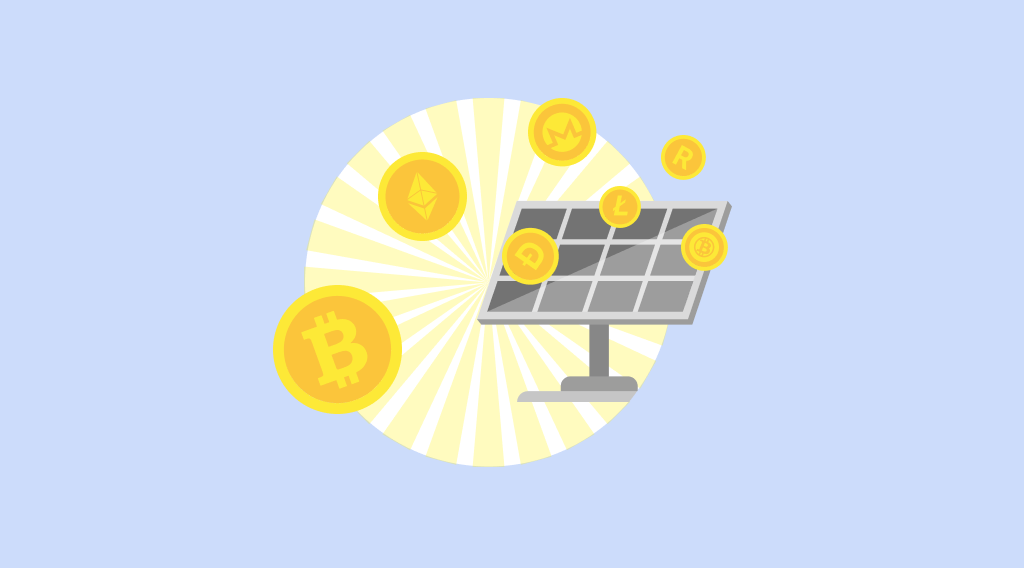
The ones that can be usefully utilized in crypto mining are:
- Solar
- Wind
- Geothermal
- Hydropower
Once an energy source has been procured, it all comes down to the question of whether it is more profitable to use this energy for mining, or simply sell it to the grid.
Green Energy: Solar and Wind
With Bitcoin prices rising, many green energy producers have become interested in crypto mining due to numerous benefits it offers, with the revenue flow being neither the last nor the least of them. Sometimes the profits generated by crypto mining surpass the wholesale energy prices by thousands of percent. Quite naturally, it is hard to ignore such profit opportunities, apart from the warm feeling of using a green and eco-friendly energy solution. This is reported to be the new norm among many energy producers, whatever their source of electricity might be.
For example, a lot of European solar energy producers are now looking into mining operations as an alternative to selling the energy to the grid for the simple reason crypto mining allows them to earn more when the energy prices are low as has been the case in recent years. Apart from earning via crypto mining, they also save enormously on energy costs incurred by purchasing electricity from the grid for everyday needs. Despite the initial costs, the cost reduction over years can be a crucial factor in turning to solar power for crypto mining operations.
Windy places are not uncommon on planet Earth, and Texas is one of such places with installed wind power capacity exceeding 28 gigawatt, mostly in West Texas. It’s little wonder it has attracted a number of high-profile mining businesses such as Bitmain as well as a bunch of notable venture capitalists looking for investment opportunities in the Bitcoin mining arena. For example, Bitmain opened a mining facility there in October, which the company was going to scale up shortly. A few big names in tech investing, including the PayPal cofounder, financed a crypto mining startup, Layer1, which also launched a mining operation in West Texas.
Hydropower and Geothermal Energy: Renewable Cryptomining Solutions
Just like with solar and wind energy production being a viable economic solution in countries with copious amounts of sunlight and wind, nations that boast vast hydroelectric capacities such as Brazil, Canada, Russia, and, ironically, China offer very cheap electricity rates to businesses, especially those next to hydroelectric facilities. It comes as no surprise that many crypto mining operations gravitate toward cheap sources of hydroelectricity, and are deployed in regions where cheap hydroelectric power is just around the corner.
Hydropower offers the lowest cost of electricity worldwide by and large, and it also turns out to be renewable as well as clean and green. These two factors make it hands down an energy source of choice for crypto mining operations. As just one illustrative example, the Siberian city of Bratsk has become home for the largest data center in the post-Soviet states, which entered into operation a little over a year ago. Dubbed BitRiver, it now serves clients from every quarter of the world, while its facilities are primarily used to mine Bitcoin – thanks to cheap electricity supplied by the nearby hydroelectric powerhouse built by the Soviets in the 1960s.
Iceland is likely not the very first location that comes to mind when the topic of crypto mining is brought up. However, the country has turned out to be a mecca for crypto mining due to its naturally low temperatures and amazing amount of easily accessible geothermal energy that provides power to big mining farms at virtually no cost. The country has surplus of electricity at extremely low prices, which comes from its geothermal, magma-fuelled powerhouses with no carbon footprint. As it stands today, crypto mining operations on this remote North Atlantic island use more electricity than all Icelandic households combined.
The Future of Crypto Mining
The takeaway from the above is that crypto mining energy needs will most likely keep on surging in the coming years, and still more so if cryptocurrencies continue on their path toward mainstream adoption and widespread acceptance. This results in serious concerns about the sustainability of the effort over the long run, both in terms of its negative environmental impact and sheer energy consumption. In light of these developments, the direction cryptocurrency mining will be taking in the near future is arguably further toward energy solutions alternative to conventional ones, especially those based on non-renewable sources such as fossil fuels, and, more generally, toward more eco friendly crypto mining – at least as long as mining profitability is maintained.
And remember if you need to exchange your coins StealthEX is here for you. We provide a selection of more than 450 coins and constantly update the list so that our customers will find a suitable option.
How to Buy Crypto?
Just go to StealthEX and follow these easy steps:
- Choose the pair and the amount you want to exchange. For instance, BTC to ETH.
- Press the “Start exchange” button.
- Provide the recipient address.
- Process the transaction.
- Receive your crypto coins.

Follow us on Medium, Twitter, Telegram, YouTube, and Reddit to stay updated about the latest news on StealthEX.io and the rest of the crypto world.
Don’t forget to do your own research before buying any crypto. The views and opinions expressed in this article are solely those of the author.
Updated July 11, 2022
crypto mining cryptocurrency mining eco friendly crypto green energy miningThe post Crypto Mining Powered by Alternative Energy Sources first appeared on StealthEX.]]>

Many people were already bothered that crypto mining is becoming less profitable in 2020 and will be meaningless very soon, but even though big companies having bigger resources took over most of the industry, cryptocurrency mining using video cards remains available to common users and still has potential.
Despite, the volatility of the cryptocurrency market hashrate of the Bitcoin blockchain network yet remains almost at the same level and that is a quite positive sign. At the moment, the most reliable option seems to be to leave mining to large ASIC-farms and return when the stock panic subsides and the prospects will be clearer.
Although Bitcoin is still the most popular cryptocurrency on the market, every year the complexity of operations necessary for its production increases, and rewards fall (after halving in May 2020, we will talk about 6.25 BTC per block). For mining many altcoins, the threshold for entry is much lower, therefore it makes sense to look for a more profitable option among them.
But first, let’s try to understand a little what conditions we need for profitable mining.
There are several crucial aspects that determine how profitable mining will be. These are such obvious things as the price of the currency or the amount of reward for the generated block.
And this is the reason it is now very difficult to calculate the possible income. One way or another, the market price of altcoins depends on the position of bitcoin, which is experiencing bad times. For several months, the world of crypto mining has been preparing for the May halving, because the reduced supply led to a significant increase in prices. This time should not have been an exception, but now when bitcoin does not rise above $5500 and risks falling below $3500, we can only make vague guesses about its potential price in May. Many analysts tend to believe that closer to the middle of April, the negative effect of the crisis should be reduced, and positive expectations from halving and a large amount of cash from investors should have a positive impact on the price of bitcoin. Altcoins, as a rule, repeat the dynamics of the first cryptocurrency and will also continue their growth to historical highs in the year’s future.
Next, you should also pay attention to the complexity of mining because it affects the time and energy spent on generating the block. Do not forget about the cost of electricity in your region, as one extra-large bill can negate all your efforts to earn money on currency mining.
Do not forget about expenses on a mining rig and it’s amortisation.
In addition to the above, you should find out how practical the chosen currency is: whether it can be exchanged for fiat or more popular coins, what fees are charged by exchanges that work with it, and what reputation it has in general.
In order to avoid unpleasant mistakes, it is easier and more reliable to check the possible profit in one of the many calculators.
Best altcoins to mine in 2020
Monero is the currency with the highest anonymity rates, which stays attractive to many users and remains one of the strongest altcoins. The specific proof-of-work hashing algorithm does not allow ASIC-miners, so it is relatively easy to mine using personal computer’s processors and graphics cards. AMD graphic cards are preferable for this task, but NVidia suits as well. The current block reward is 2.47 XMR.
Litecoin is one of the oldest Bitcoin forks, but unlike it uses a different “Script” PoW algorithm which allows less powerful GPUs to mine coins. Litecoin is on the most popular, and successful Bitcoin forks and considered one of the most stable cryptocurrencies. Block mining reward is 12.5 LTC.
Ravencoin is another Bitcoin hardfork, and like Monero’s its X16R algorithm is practically unavailable for ASIC machines. Raven keeps gaining popularity for many reasons – it has faster block time, higher mining reward (5,000 RVN at the moment) and secure messaging system.
Dogecoin is not a joke anymore. Hard to believe, but this currency once made for fun, became one of the most valuable ones. Like Litecoin it uses Scrypt algorithm and great for mining with GPUs.
One more Bitcoin fork Bitcoin Gold was made specifically to kick out ASICs and clear the road for GPUs. It may not be the fastest-growing currency, but it is definitely one of the most stable.
And remember if you need to exchange your coins StealthEX is here for you. Just go to http://stealthex.io and choose the pair and the amount for your exchange. Then follow these easy steps:
✔ Choose the pair and the amount for your exchange. For example XMR to DOGE.
✔ Press the “Start exchange” button.
✔ Provide the recipient address to which the coins will be transferred.
✔ Move your cryptocurrency for the exchange.
✔ Receive your coins.
That’s all for today. Stay safe, cause health is our most important asset.
Follow us on Medium, Twitter, Facebook, and Reddit to get StealthEX.io updates and the latest news about the crypto world. For all requests message us via support@stealthex.io
March 18, 2020
Bitcoin mining crypto mining cryptocurrency mining Ethereum mining miningThe post Mining: Weird Time to Start, a Good Time to Think first appeared on StealthEX.]]>